



What a Weddington washing machine is plumbed into
Union County Water rather than Charlotte Water, so the hardness numbers quoted elsewhere on this site are Charlotte numbers and not Weddington ones. Duke for power. On this equipment the utility detail that matters most is neither: it is that built-in refrigeration lives in a cabinet run drawing air through a narrow grille, and Weddington wooded lots and a substantial Piedmont pollen season mean condensers here load up faster than the manufacturer twelve-month interval assumes. Six months is the right schedule at a Weddington address, and it is free to do.
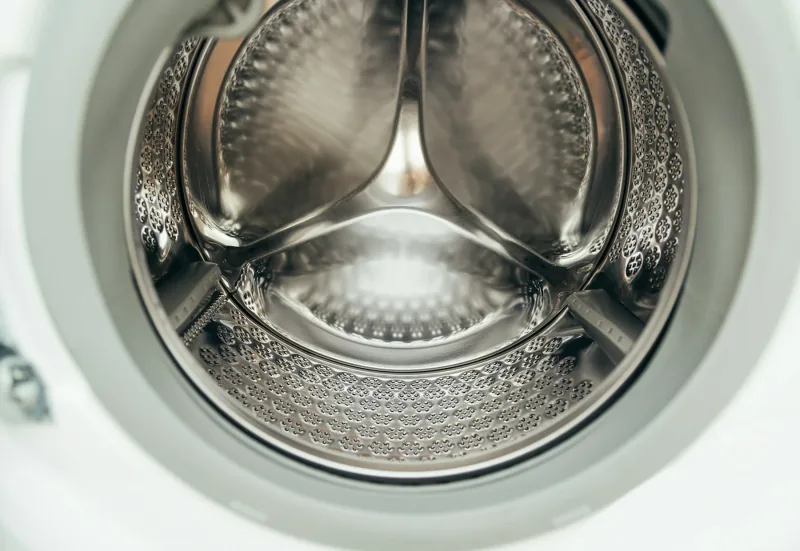
That matters because a washing machine is one of only three appliances in the house permanently connected to mains pressure, and it holds against that pressure for every hour it is not running. Two solenoid inlet valves sit closed at the back of the machine doing exactly that, roughly 165 hours a week.
Across this metro the static pressure is routinely well above 100 psi, against a code threshold of 80 psi above which a pressure-reducing valve is required in North Carolina. Plenty of houses either never had one or have one that has quietly failed open. So an inlet valve here is a wear part rather than a random failure, and the sequence is predictable: it starts to weep, which shows up as water in the drum when nobody has used the machine, then it fails outright, and eventually the supply hose behind it goes too.
That last one is the expensive one and it is barely an appliance failure at all. The Insurance Information Institute puts the average non-weather water damage claim just under $11,000, and carriers routinely treat a rubber hose that perishes with age as maintenance rather than sudden and accidental. With almost no basements anywhere in this region, a Weddington laundry room is usually sitting above finished rooms rather than below them.
So we put a gauge on the nearest hose bib on every washer call here and the reading goes on your paperwork. Above 80 psi we will tell you the real answer is a plumber and a pressure-reducing valve, which is a referral away from our own invoice. And we will fit braided stainless hoses while we are behind the machine, which is the least profitable thing on the page and the one that prevents the largest bill.
The commercial position is the same in Weddington as it is at a Charlotte address, because the rate card on this site is not a Charlotte rate card. The diagnostic visit is $89 and it comes off the invoice in full when you approve the repair. Labour beyond that is $95 to $145 an hour. Nothing is added for the drive, and if the same fault returns after we have fixed it the return visit carries no fee at all.
What Weddington itself changes
The kitchens in Weddington
Weddington is the professional-brand belt of this service area and the numbers explain why: a median household income of $190,766, owner-occupancy at 95.1%, a median build year of 2000 and 43.8% of the stock built between 1980 and 1999. Those are large houses, owned rather than rented, with kitchens specified rather than supplied. So the appliances here are disproportionately built-in refrigeration, professional ranges and fitted cabinetry rather than freestanding equipment, and the repair-or-replace arithmetic changes completely as a result. A replacement is not a purchase, it is a purchase plus a fitting plus, frequently, a joiner altering a fitted kitchen to take a unit that is not the same size as the last one.
Getting an appliance in and out
Physically the easiest properties in the service area to reach and the most complicated to work on. Long drives, wide doors, generous space, and then an appliance that is set flush into joinery, secured to the cabinet run and carrying a custom door panel matched to the kitchen. Nothing here comes out easily and nothing goes to a workshop. All the work happens in place, which is normal for this equipment and is worth stating plainly, because a proposal to remove a built-in refrigerator is a sign that somebody has not worked on one.
What is actually installed
Built-in and integrated refrigeration, professional ranges and cooktops, wall ovens in fitted apertures, panel-ready dishwashers and undercounter ice machines in bar and outdoor kitchen areas. Gas cooking is common here where it is not elsewhere. The recurring finds are the ones that come with this class of equipment: condensers that have not been cleaned since installation, door gaskets and hinges worn by heavy panelled doors, and control boards that run through a dealer parts channel with lead times measured in weeks rather than days.