

Appliance RepairCharlotte Pros
  1. Home
  2. Services
  3. Microwave Repair

Microwave Repair Charlotte, NC

Microwave repair in Charlotte is the one job we will usually tell you not to do, and there is exactly one exception. An over-the-range unit is fitted cabinetry, so replacing it costs several times what the countertop rule assumes.

Book a diagnosis

Tell us whether it is over the range, built in, or standing on the worktop.

The $89 diagnostic comes off the repair in full. If the honest answer is that the appliance is not worth fixing, or that nothing is wrong with it, you will hear that instead.

A Window, Not A Whole DayWe are based here, so a Charlotte address is the shortest drive we make. A named day and a two-hour window, with a call when the technician sets off.
The $89 Fee Comes OffPublished ranges for microwave repair, the same across the whole metro, with the diagnostic credited in full against the repair.
Part Numbers In WritingThe failed component named and shown to you, with the part number written down so you can price it independently.

Most of these calls should not become jobs

This page argues against itself for the first half, which is unusual for a service page and is the honest position. A countertop microwave is a commodity appliance costing less than most repairs, and calling anybody out to one is spending money badly. Everything changes when the appliance is screwed to the underside of a cabinet with a vent duct behind it, and that distinction is the entire subject here.

The one appliance where we usually say do not repair it, and the exception

Start with the case against. A countertop microwave is a mass-produced commodity. Attending one, diagnosing it and fitting a part costs more than most of them are worth new, and there is no arrangement of the arithmetic that makes it sensible. If yours stands on the worktop and it has stopped working, replace it. We will say so on the phone and we will not send anybody, which loses us the visit fee and is plainly the right answer.

Now the exception, and it is a large one in this market.

An over-the-range microwave is not a countertop unit in a different place. It is screwed to the underside of a wall cabinet, bolted through a mounting plate on the wall, wired into a dedicated circuit rather than plugged into a socket, and connected to the kitchen's extraction: either ducted out through the wall or the roof, or recirculating through a charcoal filter. It is a fitted appliance and it is part of the kitchen.

That changes the replacement cost in three ways at once:

  • The aperture. Over-the-range units are near-standard at 30 inches wide, but the height between the hob and the cabinet above is not standardised, and the cabinet above is frequently a shortened one built for the original appliance. A replacement an inch taller does not go in.
  • The duct. The exhaust connection has to line up with the existing duct, and models differ in whether they exit at the top or the back and which knockout they use. A mismatch means ductwork.
  • The electrical connection. It is a hard-wired or dedicated circuit, which makes fitting one an electrical job rather than a plug-in.

Add those together and replacing an over-the-range microwave is regularly $600 to $900 fitted rather than the $250 the shelf price suggests. Against a repair at $130 to $310, the fifty percent rule stops applying, because the two things being compared are no longer comparable. The fifty percent rule was written about an appliance you can carry.

The same is true, more strongly, of a built-in microwave in a trim kit or a combination microwave and wall oven unit, both of which turn up in the newer south Charlotte, Waxhaw and Weddington kitchens. There the trim kit is model-specific and the aperture is joinery.
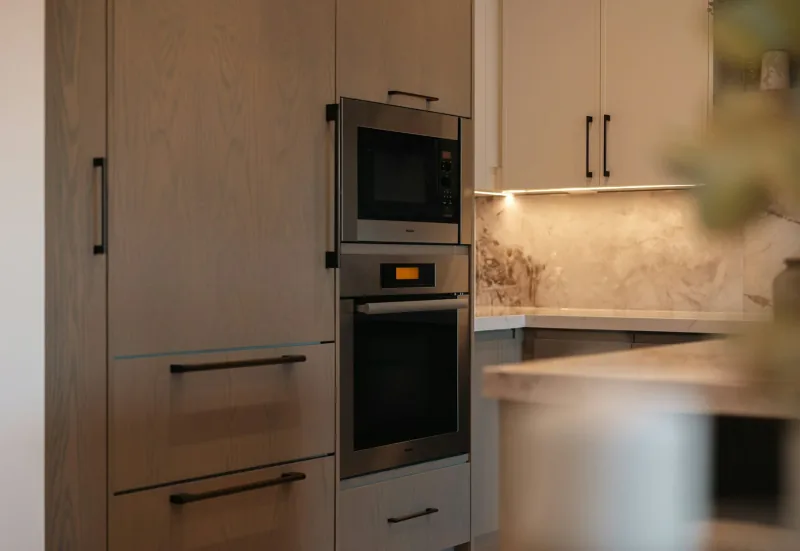
A built-in oven and microwave stacked together in a run of pale fitted kitchen cabinetry.

It runs but nothing gets hot: the real diagnosis

The commonest microwave complaint by a distance. The turntable turns, the light is on, the fan runs, the timer counts down, and the food comes out cold. That is a fault in the high-voltage side, and there are four candidates.

  • The door interlock switches. Usually three of them, in series, and they are the first thing to check. A microwave will not energise unless every switch agrees the door is shut, and one failing open produces exactly this symptom. They are inexpensive parts and it is the most common cause. Worth knowing that a door which has been slammed for years, or a latch that has worn, will kill these switches repeatedly.
  • The high-voltage diode. A cheap component that fails often, usually shorted. A classic sign is a loud hum or a buzz on start, with no heating.
  • The high-voltage capacitor. Less common, and dealt with below.
  • The magnetron. The tube that actually generates the microwaves. It is the most expensive part in the appliance and it is diagnosed last, not first, because the three cheaper components above account for most of these faults.

The safety part, which is not a formality

A microwave capacitor stores a lethal charge and it holds it after the appliance is unplugged. This is not the ordinary electrical caution that attaches to any appliance repair. It is a genuinely dangerous stored energy in a domestic box, at a voltage and a current that will kill, and it does not dissipate quickly on its own. Discharging it properly through a resistor before touching anything is the first step of every microwave job, and it is the reason this is the one appliance on this site where we would actively discourage a competent DIY attempt. There are plenty of things worth having a go at yourself. This is not one.

Other faults

A touch panel or membrane that has stopped responding is common on older units and the part is frequently discontinued, which ends the appliance. The turntable motor is cheap and easy. Sparking or arcing inside the cavity means the waveguide cover has burnt through, which is a $10 part and needs doing before the arcing damages the cavity wall.

The extraction, and the thing above a Charlotte hob

An over-the-range microwave does a second job that gets forgotten until it stops: it is the extraction over your hob. And in this metro that arrangement is close to universal in the post-2000 subdivision stock, because it saves a separate hood and a cabinet.

Two things go wrong with it.

It was never ducted in the first place. A large proportion of these installations are recirculating: the fan draws air through a charcoal filter and pushes it straight back into the kitchen through the vent at the top. That removes smell to a degree and removes essentially no heat and no moisture. Where a house was built with a recirculating installation and there is an exterior wall directly behind the appliance, converting it to a ducted one is genuinely worthwhile and is a moderate job.

Nobody changes the filters. There are two. The grease filters underneath are metal mesh and go in the dishwasher, and they want doing monthly. The charcoal filter inside the top is only present on recirculating installations, cannot be cleaned, and is meant to be replaced every six to twelve months. A blocked grease filter makes the fan work against a wall and it is the usual reason an over-the-range unit is noisy or feels weak.

There is a heat consequence too, and it is why these appliances have a shorter life than most: an over-the-range microwave spends its whole life directly above a hob, so its electronics live in rising heat from whatever is cooking below. Mean service life for one is nine to ten years, the shortest of any major kitchen appliance, and that is the reason. Where a control panel goes on a nine-year-old unit, the discontinued-part question arrives quickly, and we check it before quoting.

What the job covers in Charlotte

What we cover

Over-the-range and cabinet-mounted built-in microwaves, including the combination microwave and wall oven units common in the newer housing stock here.

Target outcome

A straight answer on whether the appliance is worth attending at all, and where it is, a repair carried out with the capacitor properly discharged.

Decision point

We tell people not to repair countertop microwaves, because an attendance fee against a replaceable appliance is not a service, it is a way of charging for a visit.

How a Charlotte microwave repair goes with us

No tablet, no three tiers, no trip to the van to check with the office. This is exactly what happens, so you know what you are agreeing to before you agree to it.

01

Tell us where it is mounted

Countertop, over the range, or built into a cabinet with a trim kit. That single answer determines whether this is a job worth doing at all, and if it is countertop we will tell you not to book a visit.

02

The capacitor discharged before anything else

It holds a lethal charge after the appliance is unplugged and it does not bleed off on its own. Discharging it through a resistor is the first physical step of the job every time, without exception.

03

Interlocks and diode before the magnetron

Three cheap components account for most no-heat faults and the expensive one accounts for the rest. Testing in that order costs us the larger part sale and gets a great many of these appliances working for a modest price.

04

The aperture and the duct measured on a built-in

Width, the height between hob and cabinet, and where the exhaust exits. Those decide what a replacement would genuinely cost, which is what the repair should be weighed against rather than a shelf price.

05

Filters checked, and the extraction tested

Grease filters and, on a recirculating installation, the charcoal one. A blocked filter is the usual reason one of these feels weak or sounds noisy, and it is a maintenance answer rather than a repair.

What microwave repair costs in Charlotte

All-in, parts and labour, sales tax included, with the $89 diagnostic credited against the repair. Over-the-range and built-in appliances only. We do not attend countertop microwaves and will say so on the phone.

JobTypical Charlotte rangeNote
Door interlock switches$130 – $220Three switches in series and the commonest cause of an appliance that runs without heating.
High-voltage diode$140 – $230A cheap component that fails often. The loud buzz on start with no heating is the classic sign.
Door latch assembly or handle$150 – $260A worn latch destroys interlock switches repeatedly, so replacing the switches alone is a short repair.
Turntable motor or coupler$120 – $200Cheap and straightforward. Worth doing, because uneven heating is mostly a turntable problem.
Waveguide cover$110 – $180Arcing inside the cavity. A small part, and it wants doing before the arcing marks the cavity wall.
Extraction fan motor$180 – $310The hood half of the appliance. Checked with the grease filters, which are usually the real answer.
Magnetron$260 – $420Diagnosed after the interlocks, the diode and the capacitor, never before them.
Touch panel or membrane$240 – $400Frequently discontinued past about eight years, which ends the appliance. Availability checked first.
Grease and charcoal filter service$90 – $150Monthly for the grease filters and twice a year for the charcoal. The reason most of these feel weak.
Countertop microwaveNot attendedThe repair exceeds the appliance. We tell you on the phone rather than charging for the conclusion.

How our pricing works

Five things that are true on every job, in every town we cover.

  • Parts, labour and sales tax are in the number.All-inclusive pricing with no hidden fees, so the figure we agree before the work is the figure on the invoice.
  • The $89 diagnostic is credited in full.You pay it only if you decide not to go ahead, and a return visit for the same fault carries no fee at all.
  • The price is agreed before the work starts and it does not move.The number does not move once you have agreed to it, unless you approve a change in scope first.
  • No deposit until the part is ordered.And the part number goes to you in writing, so you can check its price and lead time against the supplier yourself.
  • Nobody here works on commission.Our technicians are paid to diagnose and repair, so no one earns more by telling you an appliance is beyond saving.

The ranges above are typical for the Charlotte market, published so you have something to measure any figure against, including ours. They are not quotes, and the price is confirmed before any work begins. The number that matters is the one agreed after the fault has been diagnosed and the part identified.

Why homeowners call us for microwave repair

Six commitments that apply to every job we take, whatever the appliance turns out to need.

We will tell you not to repair itOn a countertop unit the repair costs more than the appliance and we say so on the phone rather than sending someone. That is a visit fee we decline, and it is the only honest answer on that appliance.
Built-ins are priced against a fitted replacementAn over-the-range unit replaced properly is regularly $600 to $900 with the electrical work and any ductwork, not the $250 on the shelf. That is the number a repair should be compared with, and it is usually left out.
The magnetron is diagnosed lastThree interlock switches and a high-voltage diode account for most no-heat faults, and all four parts together cost less than the magnetron. Testing in that order is slower and considerably cheaper for you.
The capacitor is treated as genuinely dangerousBecause it is. A stored charge that persists after unplugging and will kill is not the ordinary caution attached to appliance work, and it is the one repair on this site we actively discourage anyone from attempting.
We look at the extraction, not just the cookingAn over-the-range microwave is also the hood over your hob. Grease filters monthly, charcoal filters twice a year on a recirculating installation, and a genuine answer about whether yours is ducted at all.
Every rate on this site is published before you call.The diagnostic fee, the hourly labour rate and the repair ranges by appliance, with parts, labour and sales tax already in the number.
Call 704-555-0186 ›

Microwave Repair in Charlotte, answered

With the local water chemistry, pressure and code rules that actually apply here.

How much does microwave repair cost in Charlotte?

For over-the-range and built-in appliances, $130 to $310 all in, with the $89 diagnostic credited against it. Door interlocks and a high-voltage diode sit at the bottom, a magnetron at $260 to $420 or a touch panel at $240 to $400 at the top. For a countertop microwave the answer is that we do not attend them, because any repair costs more than the appliance is worth, and we will tell you that on the phone rather than charging you for the conclusion.

Is it worth repairing a microwave at all?

It depends entirely on how it is mounted. A countertop unit, no: replace it, and we will say so without sending anybody. An over-the-range or built-in unit, usually yes, because replacing one properly is $600 to $900 once you include the electrical connection, any ductwork and the risk that a current model will not fit the aperture. That is what a repair should be measured against, and it is a very different number from the shelf price the fifty percent rule assumes.

My microwave runs but the food stays cold. What is broken?

Something in the high-voltage side, and there are four candidates in order of likelihood. The door interlock switches, three of which sit in series and any one of which will prevent the appliance energising while everything else runs normally. The high-voltage diode, which is cheap and fails often, usually with a loud buzz on start. The capacitor. And last, the magnetron, which is the expensive one and accounts for the minority of these faults despite being the first thing most people assume.

Can I repair a microwave myself?

This is the one appliance on this site where we would say no. The high-voltage capacitor stores a lethal charge and it holds that charge after the appliance is unplugged, at a voltage and current that will kill rather than startle. It has to be discharged through a resistor before anything inside is touched, and that is not an ordinary precaution. There are plenty of appliance jobs worth attempting yourself. Opening a microwave is not among them, and no saving justifies it.

There is sparking inside my microwave. What is causing it?

Almost always the waveguide cover, which is the small panel on the cavity wall covering the opening where the microwaves enter. It is usually mica or a similar board, and food splashes soak into it, carbonise and then arc. It is an inexpensive part and a straightforward replacement, but it wants doing promptly, because sustained arcing burns through into the cavity wall and that is not repairable. Stop using the appliance until it is done. Metal in the cavity is the other cause and is obvious.

How often should I change the filters on my over-the-range microwave?

The metal grease filters underneath want washing monthly and they go in the dishwasher. The charcoal filter, which only exists on recirculating installations, sits behind the vent at the top, cannot be cleaned, and should be replaced every six to twelve months. A blocked grease filter makes the extraction fan work against a wall, which is the most common reason one of these sounds noisy or feels weak, and it is maintenance rather than a fault.

Does my over-the-range microwave actually vent outside?

Quite possibly not. A large share of the installations in this metro are recirculating, meaning the fan draws air through a charcoal filter and returns it to the kitchen through the vent at the top rather than sending it outdoors. That removes some smell and effectively no heat or moisture. If there is an exterior wall directly behind the appliance, converting it to a ducted installation is a moderate job and a genuine improvement. We will tell you which one you have while we are up there.

How long should an over-the-range microwave last?

Nine to ten years, which is the shortest life of any major kitchen appliance, and the reason is where it lives. It spends its entire service life directly above a hob, so its electronics sit in the rising heat of everything cooked below them, which is a far harder environment than a countertop unit ever experiences. That short life is also why the discontinued-part question arrives quickly on these: a touch panel failing at nine years is frequently no longer manufactured, and we check before quoting.

Will a new microwave fit where the old one was?

Worth checking rather than assuming. Over-the-range units are near-standard at 30 inches wide, but the height between the hob and the cabinet above is not standardised, and that cabinet is often a shortened one built around the original appliance. The exhaust also has to line up: models differ in whether they vent at the top or the back and which knockout they use. We measure the width, the height and the duct position while we are diagnosing, so you have real numbers before deciding.

Why does my microwave heat unevenly?

Start with the turntable, because a motor or coupler that has failed leaves food sitting in one spot in a standing wave pattern and that produces exactly this. It is a cheap part. After that, a magnetron that is weakening rather than dead will heat, slowly and unevenly, which is harder to diagnose than an outright failure and is measured by timing a known volume of water. And check the waveguide cover, since a partly burnt one distorts the field as well as arcing.

Places we perform this service as well

Every place has its own page, because the water, the permit office and the housing stock are not the same across the metro and all three change the job.

All service areas ›

Need microwave repair in Charlotte?

A free diagnosis on the phone, then a written price before any work starts. If the fix is something you can do yourself, we will tell you.

  • EPA 608 Certified
  • Fee Credited To The Repair
  • Published Repair Prices

Book a diagnosis

The appliance, the brand, and what it does at which point in the cycle.

The $89 diagnostic comes off the repair in full. If the honest answer is that the appliance is not worth fixing, or that nothing is wrong with it, you will hear that instead.