



Running is not the same as working
A freezer that has stopped is easy. A freezer that hums away exactly as it always has while the contents slowly soften is the call that confuses people, because every visible sign says the appliance is fine. It usually is fine. What has failed is the cycle that keeps the evaporator clear, and once that coil is buried in ice the machine can make all the cold it likes and none of it reaches the food.
A freezer that runs and still climbs is a defrost fault
Every frost-free freezer, and the freezer half of every frost-free refrigerator, runs an automatic defrost cycle several times a day. A small heater warms the evaporator coil for a few minutes, the accumulated frost melts, the water runs down a drain into a tray, and the appliance goes back to work. Without that cycle the coil accumulates frost load by load until it is a solid block of ice.
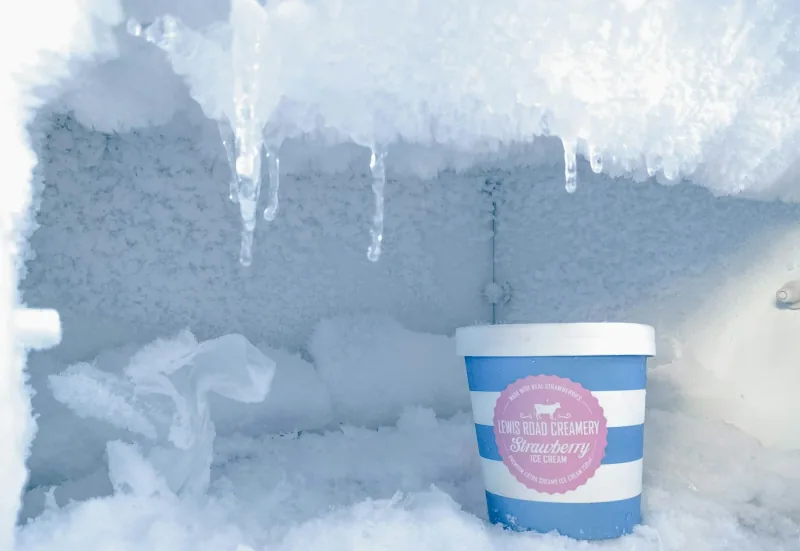
At that point the appliance is still refrigerating perfectly. The compressor runs, the coil gets cold, and none of it matters, because the evaporator fan can no longer push air through a block of ice. Temperature in the cabinet climbs slowly over days while every audible sign says the machine is working. It is one of the few appliance faults that genuinely looks like nothing is wrong.
Three components run that cycle and any one of them ends it:
- The defrost heater, a low-wattage element wrapped around or under the evaporator. Open circuit, no defrost. Testable with a meter in a minute.
- The defrost thermostat or bimetal, which closes only when the coil is cold enough to need defrosting. Fails open, and the heater never gets its supply.
- The timer or the control board, which decides when the cycle runs. On older appliances a mechanical timer, on newer ones a function of the main board.
The diagnostic is straightforward and worth knowing. Take the back panel off inside the freezer. If the coil is buried in ice, the defrost circuit has failed and the cooling side is innocent. If the coil is clear and frosted only lightly and the cabinet is still warm, then you are looking at the sealed system instead, and that is a different price and a different qualification, described on the refrigerator page.
You can also get yourself out of trouble temporarily: unplug it, leave the door open for twenty-four hours with towels down, and the ice will melt. The freezer will then work perfectly for a few weeks before doing the same thing again, because the manual defrost fixed the symptom and not the circuit. Plenty of people live like that for years without realising a modest repair would end it.
The reason this distinction is worth a whole section is what it does to the price. A defrost circuit fault is a heater, a bimetal or a timer, which is $150 to $330 all in and sits entirely outside the sealed system. A genuine cooling failure on the same appliance is sealed-system work at $700 and up, and on a chest freezer that figure frequently exceeds what the machine is worth. Same symptom to the person standing in front of it, five times the money, and the two are separated by taking one panel off. That is why nobody should be quoting either number down the phone, including us.
Where the freezer is standing, and the rating nobody reads
Here is the local half of this, and it is a genuine Charlotte problem rather than a general one.
About 3% of Mecklenburg County homes have a basement. That single structural fact decides where the second freezer goes, because there is nowhere else for it: it goes in the garage. Across the newer subdivision stock in Denver, Huntersville, Concord, Harrisburg and Indian Trail, a chest or upright freezer in an attached garage is close to standard equipment, and in the larger post-2000 houses out towards Lake Norman a second refrigerator usually joins it.
The problem is that most domestic freezers carry an ambient temperature rating, and an attached Carolina garage in July is regularly outside it. The rating is a design condition, not marketing: the thermostat, the refrigerant charge and the compressor duty cycle are all sized around an expected room temperature. Two things go wrong outside that band, and they pull in opposite directions.
- Too hot, and the appliance cannot reject its heat. The condenser is trying to dump warmth into air that is already at 105F, so the compressor runs continuously, the cabinet never quite reaches its set point, and the appliance wears at several times its intended rate. That looks like a failing freezer and it is a working freezer being asked to do something it was not built for.
- Too cold, and it stops running at all. This one surprises people. On many standard freezers the thermostat is sensing cabinet temperature, and on a January morning at 25F in an unheated garage it decides the cabinet is cold enough and switches off. The compressor stops, the cabinet drifts up towards ambient, and food partially thaws in the middle of winter.
The answer is a garage-ready model, which manufacturers sell specifically for this and which carries a wider ambient range and, on many, a heater in the control circuit for the winter case. If yours is not one, no repair will change that, and we would rather tell you than replace the same thermostat every August. Where the appliance is genuinely garage-rated and still struggling, the usual culprits are far more mundane: a condenser coil furred with garage dust, or a unit pushed hard against a wall with no clearance to breathe.
Chest against upright, and what a failure costs you
The two formats fail differently and it is worth knowing which you have before you ring anyone.
Chest freezers are usually manual defrost with the evaporator coil bonded into the cabinet walls, which means there is no defrost circuit to fail and no fan to stop. Mechanically they are the simplest cold appliance in the house: a compressor, a thermostat, a light and a lid seal. When one does fail it is far more likely to be genuinely the sealed system, and on an appliance whose replacement cost is modest that decides the question quickly. The lid seal is the one thing worth checking yourself, because cold air sits in a chest freezer and a poor seal costs less than it does on an upright.
Upright freezers are mostly frost-free, which means they carry the whole defrost circuit described above and an evaporator fan besides. More to go wrong, more of it repairable, and a much higher proportion of faults sitting comfortably outside the sealed system.
Food loss, and what to do in the first hours
This is the part of the job that actually matters to people and it rarely gets discussed. A full freezer holds temperature for roughly 48 hours unopened, and a half-full one for about 24. So the single most useful thing you can do is keep it shut and, if you have space, consolidate the contents into the fullest possible arrangement. Bagged ice or dry ice buys another day. We treat freezer calls as urgent for exactly this reason and pull them forward in the day where the schedule allows, because a repair that arrives on Thursday for a Tuesday failure has cost you more than the repair.
What the job covers in Charlotte
What we cover
Standalone chest and upright freezers, garage units, and the freezer compartment of a combination refrigerator.
Target outcome
The defrost circuit tested properly, the ambient rating of the appliance checked against where it actually stands, and food loss minimised while the work happens.
Decision point
We check the location and the ambient rating before condemning a freezer, because a garage freezer failing every summer is frequently a correctly working appliance in the wrong place.