


Half working is a clue, not a mystery
When a range half works, the instinct is to assume the brain has gone. It almost never has. A 240-volt appliance is fed by two separate 120-volt legs, and the components split between them, so losing one leg produces exactly the pattern people describe: the clock is fine, two burners work, the oven does nothing. Reading that pattern correctly is the difference between a cheap repair and an expensive one.
The terminal block, and why it is diagnosed as a control board
About three quarters of North Carolina homes run electric for their major appliances, so most of the ranges in this metro are 240-volt. That supply is not one wire. It is two hot legs at 120 volts each, and the appliance divides its load between them: the oven element wants both, individual surface elements are split across them, and the clock, the light and the electronics usually sit on one.
Now lose a leg. The clock still shows the time. Two burners heat and two do nothing. The oven will not come on at all, or comes on and never reaches temperature. From the front of the appliance that reads as a control failure, and it is quoted as one constantly.
There are only three places a leg goes missing, and two of them are free to check.
- The breaker. A range runs on a double-pole breaker, and one half can trip while the other holds. It does not always look tripped. Switching it fully off and back on costs nothing.
- The terminal block at the back of the range. This is where the supply cord lands on a set of screwed terminals, and it carries the entire load of the appliance through a mechanical connection. Over years of heating and cooling that connection loosens fractionally, resistance rises, the joint gets hot, the plastic block chars, and eventually one leg goes open. When we pull a range off the wall and find a black, crazed block with a discoloured lug, that is the whole diagnosis and it is visible from three feet away.
- The cord itself, or the receptacle, which suffers the same way for the same reason.
A terminal block is a part costing tens of dollars. A range control board is several hundred with a lead time. We check the block on every partly-working range before anything else is discussed, and we photograph it, because a charred block is the kind of evidence that ends an argument.
It is worth adding that this is not merely an appliance issue. A connection hot enough to char its own housing is a connection generating heat inside your kitchen wall. If the receptacle or the house wiring is involved rather than the appliance-side block, that is licensed electrical work in North Carolina and we hand it over rather than tidying it up. The same failure, for the same reason, is described on the dryer page, because a dryer is fed the same way.
Electric, gas and induction fail in three different vocabularies
Electric coil and radiant
The infinite switch is the most common failure and the least well known. It is the control behind each knob, and it does not vary power like a dimmer: it cycles the element fully on and fully off, and the knob sets the ratio. When one wears out the burner sticks on full, or will not come on, or works only at one setting. It is a modest part, it is mechanical, and it is regularly mistaken for a failed element.
Elements themselves fail visibly. A radiant element under a ceramic top usually shows a bright spot or a break; a coil element blisters or arcs. Both are straightforward, but a coil element that arcs will often have damaged its receptacle block too, and replacing one without the other is a short repair.
Gas
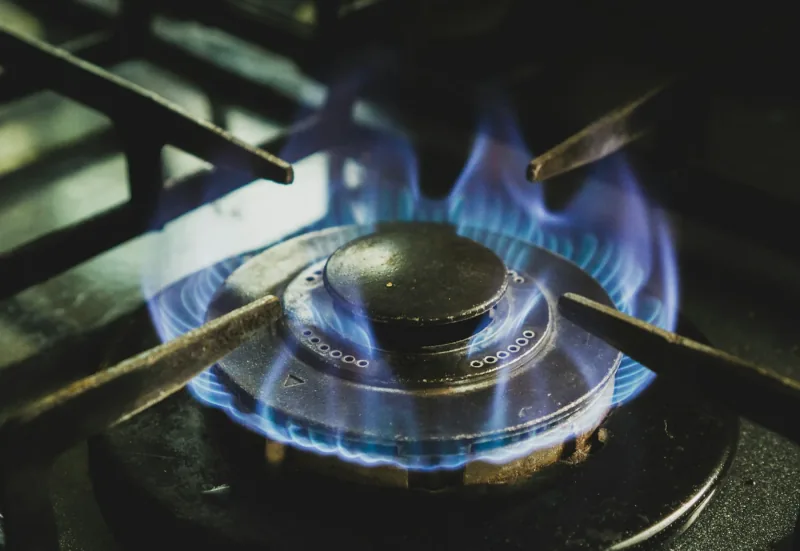
A burner that clicks and clicks without lighting is nearly always a wet or dirty spark electrode, and often it lights anyway while the neighbouring burners keep clicking. That is a cleaning job rather than a part. A burner with a lazy yellow flame has a blocked port or a misaligned cap. The oven side runs on a bake igniter that draws current to open the gas valve, and igniters weaken with age: it glows, but it no longer draws enough to pull the valve open, so you get a glow and no gas. That is measurable with a clamp meter and it is the standard gas oven repair.
What we do not do is work on the gas supply line. Reconnecting the appliance is part of the job; the line is licensed work under the North Carolina plumbing and heating board.
Induction
Rare in older housing here and increasingly common in the newer stock and in the professional-brand belt around Weddington and south Charlotte. Induction is essentially a power-electronics appliance: each hob has its own inverter board, and cooling is by fan through a filtered intake. The overwhelmingly common failure is heat, not the coil. A blocked intake or a failed cooling fan makes the board shut down mid-cook, which reads as an intermittent fault. Cleaning the intake fixes more induction hobs than any part we fit.
When a range is genuinely finished
A gas range averages 14.5 years of service life and an electric one is broadly similar, so a great many of these repairs are comfortably worth doing. Three situations genuinely end one.
The oven cavity liner has rusted through. Usually at the bottom, under a spill that sat. Once the liner is perforated the insulation behind it is wet and the appliance is not repairable in any sensible sense.
The ceramic top is cracked. A glass top is a structural part and a safety part, and on many models the replacement top is priced close to a new range. On a slide-in in a fitted run it can still be worth doing, for the reason described below.
The board is discontinued. The usual ending for anything electronic past about ten years, and the reason we check availability before taking a deposit rather than after.
The one place the standard arithmetic misleads is a slide-in range in a fitted cabinet run, which is common in the post-2000 kitchens across Concord, Huntersville and Indian Trail. A freestanding range is a shop purchase you wheel in. A slide-in is cut into a worktop with a specific width, depth and control-panel height, and finding a modern replacement that drops into a twenty-year-old aperture without joinery is not a given. So a $400 repair on a slide-in is not competing with the shelf price of a range; it is competing with the shelf price plus a worktop alteration. We will say so rather than applying the fifty percent rule to something it was not written for.
What the job covers in Charlotte
What we cover
Freestanding ranges, slide-in ranges and separate cooktops in electric, gas and induction, across every mainstream and professional brand.
Target outcome
The supply checked before the appliance is condemned, the failed component named, and any gas or wiring work handed to the trade licensed to do it.
Decision point
We check the terminal block and the breaker before quoting a control board, because a partly working range is a supply symptom far more often than an electronics one.