


Appliance RepairCharlotte Pros
  1. Home
  2. Services
  3. Sub Zero Repair

Sub Zero Repair Charlotte, NC

Sub Zero repair in Charlotte turns on two things the rest of the trade does not deal with: a built-in runs two independent sealed systems, and the condenser wants cleaning every six to twelve months.

Book a diagnosis

Tell us the model series if you can reach the plate, and which compartment is warm.

The $89 diagnostic comes off the repair in full. If the honest answer is that the appliance is not worth fixing, or that nothing is wrong with it, you will hear that instead.

A Window, Not A Whole DayWe are based here, so a Charlotte address is the shortest drive we make. A named day and a two-hour window, with a call when the technician sets off.
The $89 Fee Comes OffPublished ranges for sub zero repair, the same across the whole metro, with the diagnostic credited in full against the repair.
Part Numbers In WritingThe failed component named and shown to you, with the part number written down so you can price it independently.

This is not a bigger version of a normal fridge

Built-in refrigeration is a different discipline, and the biggest single difference is architectural rather than mechanical: on the classic built-in series there are two entirely separate refrigeration circuits inside one cabinet. That changes what every symptom means. On an ordinary refrigerator a warm compartment with a cold one beside it points at airflow. Here it points at one of two independent systems, and the two conclusions are nothing alike.

Two sealed systems, and what that does to the diagnosis

The classic Sub-Zero built-in series runs two independent sealed systems: one compressor, condenser and evaporator dedicated to the refrigerator, and a completely separate set dedicated to the freezer. The stated reason is food preservation, because the refrigerator side can then be held at a higher humidity without freezer air drying it out, and it works.

The consequence for repair is that every symptom means something different from what it would mean on an ordinary appliance.

On a normal domestic refrigerator, all the cold is made in the freezer and blown into the fridge compartment, so a warm fridge with a working freezer proves the refrigeration is fine and points at a fan, a defrost fault or a damper. That reasoning is on the refrigerator page and it is correct for the overwhelming majority of appliances.

On a dual-system built-in it is wrong. A warm refrigerator with a perfectly cold freezer here means the refrigerator's own sealed system, its own compressor or its own evaporator, is the candidate, because the freezer's health tells you nothing whatever about the refrigerator's. The two circuits share a cabinet and almost nothing else.

That cuts both ways and it is genuinely useful. Where one compartment is fine, the food in it is safe while the other side is dealt with, so a failure here is rarely the total loss it would be on a single-system appliance. And where both compartments are struggling at the same time, two independent systems failing simultaneously is improbable, so the fault is almost certainly something they share: the condenser, the airflow to it, or the electrical supply. That is nearly always better news.

There is a third consequence, and it is the one that decides money. Because the circuits are independent, they can be repaired independently. A sealed-system failure on the refrigerator side does not condemn the freezer side, and a compressor replacement is quoted per circuit rather than for the appliance. On a single-system refrigerator a compressor failure is effectively the end of the machine. Here it is the end of half of it, and the other half carries on working through the repair. That is a large part of what the original purchase actually bought.

It also changes what we ask on the phone. On an ordinary refrigerator the useful question is which compartment is warm, because the answer separates a fan from a compressor. On one of these it is still the first question, but the answer means something close to the opposite, and applying the ordinary reasoning to this equipment produces a confident diagnosis that is wrong. That is worth knowing before you ring anybody, because the reasoning is not obscure and a technician who has not met a dual-system appliance will not volunteer that they have not.

Everything about the sealed system on the refrigerator page applies here too, including the EPA Section 608 requirement under 40 CFR Part 82 Subpart F. It applies twice over, because there are two circuits.
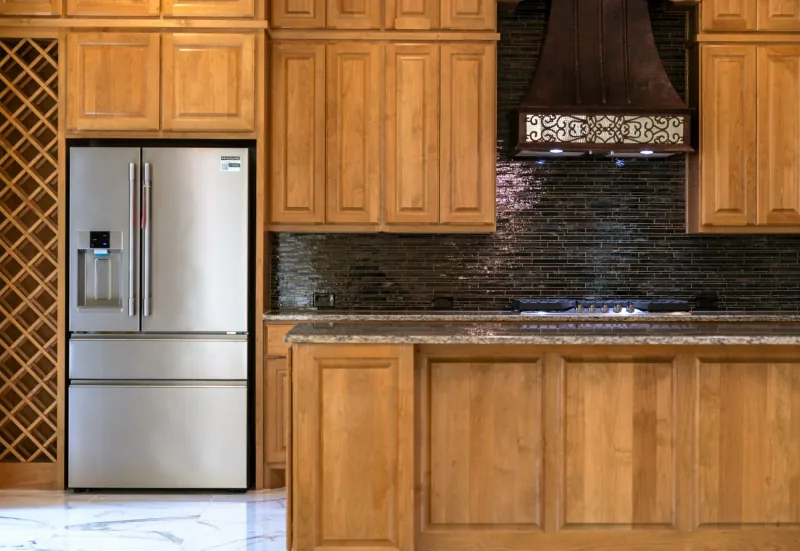
A stainless steel refrigerator set into a run of fitted wooden kitchen cabinetry beneath a tiled splashback.

The condenser, and the six-month schedule that prevents most of this

Sub-Zero themselves specify condenser cleaning every six to twelve months, and every six in a home with pets. It is in their own service documentation, it is not a marketing schedule, and a large share of the faults we attend on this equipment trace back to it not having been done.

The mechanism is straightforward. The condenser rejects the heat the appliance removes from the food. On a built-in it sits behind the upper grille at the top of the unit, where it is completely out of sight, drawing air through a narrow slot in a cabinet run. Fur that with dust and pet hair and the appliance cannot shed heat. The compressor then runs longer and longer cycles trying to reach a set point it can no longer make, and on a dual-system appliance both systems suffer at once, which is exactly the both-compartments-warm symptom that looks alarming.

Three things worth knowing:

  • The upper grille comes off by hand on most models and the condenser can be vacuumed with a soft brush attachment. This is genuinely an owner job and we would rather you did it than paid us to.
  • The screen on the built-in series is part of the sealed-system assembly and does not come out. Where debris has packed behind it that a vacuum cannot reach, low-pressure compressed air is the tool, not a screwdriver.
  • Many models carry a clean condenser reminder. If yours has been showing one, it is not being over-cautious.

There is a Charlotte-specific edge to this. The Piedmont pollen season is substantial and a kitchen collects it, and this equipment concentrates in the larger houses out around Weddington, Waxhaw, south Charlotte and the Lake Norman shore, which are precisely the wooded, high-canopy lots where airborne debris is heaviest. Six months is the right interval here rather than twelve.

We include a full condenser service on every visit to this equipment, whatever we came for. It is the cheapest thing on the invoice and it prevents more of the expensive ones than anything else we could do.

The appliance is cabinetry, and that changes the arithmetic

A built-in refrigerator is not an object standing in a kitchen. It is set flush into a cabinet run, secured to the surrounding joinery, frequently carrying a custom door panel made to match the units, and on many installations it is trimmed in at the top with a filler built specifically around it.

So there is no meaningful shelf price to compare a repair against. Replacing one means the appliance, the fitting, quite possibly a new door panel made to match the existing kitchen, and the real possibility that a current model does not match the old aperture, in which case a joiner is altering a fitted kitchen. That is why a repair figure that would be absurd on a freestanding refrigerator is frequently the sensible decision here.

It also means the work happens in place. This equipment does not go to a shop. Anyone proposing to take it away has not understood what they are looking at.

Where this equipment actually is

Worth being honest about the market. This is not a metro-wide appliance. It concentrates in a small number of places: Weddington, where median household income is $190,766 and owner-occupancy is 95.1%, the south Charlotte corridor through Myers Park, SouthPark and Ballantyne, Waxhaw, and the larger Lake Norman properties around Cornelius, Davidson and Denver. Outside those, a Sub-Zero is an occasional find rather than an expectation.

Wolf, Thermador and Viking

The same customers and usually the same kitchens, and the same principle applies: the appliance is fitted, so it is priced against a fitted replacement. Wolf cooking equipment is mechanically robust and its usual failures are igniters, spark modules and control boards. Thermador and Viking ranges and wall ovens sit in the same territory. Across all of them the constraint is parts: these are lower-volume appliances, the components run through a dealer channel rather than a general supply chain, and lead times are longer. We check availability at the diagnosis rather than after taking money, and on this equipment that check matters more than it does anywhere else on this site.

What the job covers in Charlotte

What we cover

Sub-Zero built-in and integrated refrigeration, plus Wolf, Thermador and Viking cooking and cold appliances across the Charlotte metro.

Target outcome

A diagnosis that treats the appliance as two independent systems rather than one, carried out in place, because this equipment does not leave the cabinetry.

Decision point

We publish the condenser cleaning schedule the manufacturer specifies, because neglecting it is behind a large share of the faults on this equipment and it costs nothing to correct.

How a Charlotte sub zero repair goes with us

No tablet, no three tiers, no trip to the van to check with the office. This is exactly what happens, so you know what you are agreeing to before you agree to it.

01

Tell us the series and which compartment is warm

The model plate is usually behind the upper grille. On a dual-system appliance which compartment is affected is the diagnosis rather than a detail, because the two circuits tell you nothing about each other.

02

The condenser inspected before anything else

Behind the upper grille, and out of sight for years on most installations. Both compartments struggling at once is far more often a blocked condenser than two independent sealed systems failing in the same week.

03

Diagnosed in place, because it does not move

A built-in is set into the cabinetry and secured to it. All the work happens where the appliance stands, and anyone proposing to take it away to a workshop has misunderstood what they are looking at.

04

Parts availability confirmed before any deposit

These are low-volume appliances running through a dealer channel rather than a general supply chain, so lead times are longer and availability is genuinely variable. That check matters more here than anywhere else.

05

Condenser service included, whatever we came for

Every visit. It is the cheapest line on the invoice and it prevents more expensive ones than anything else, and the manufacturer schedule of six to twelve months is not being over-cautious.

What sub zero repair costs in Charlotte

All-in, parts and labour, sales tax included, with the $89 diagnostic credited against the repair. A full condenser service is included on every visit to this equipment at no additional charge.

JobTypical Charlotte rangeNote
Condenser service, on its own$140 – $220Every six to twelve months per the manufacturer. Included free with any other work on the same visit.
Evaporator or condenser fan motor$260 – $420Outside the sealed system. On a dual-system appliance, specific to whichever side is affected.
Defrost heater or thermostat$250 – $410Each circuit has its own, so the fault is identified to a compartment rather than to the appliance.
Thermistor or control sensor$220 – $360A compartment holding the wrong temperature while everything else behaves normally.
Door gasket, per door$280 – $460On a flush-fitted appliance a tired gasket also shows as frost at the door edge and a running compressor.
Door hinge or closer cartridge$260 – $430These doors carry a fitted panel and are heavy, so hinges are a genuine wear item rather than a rarity.
Control board or user interface$420 – $780Dealer-channel part with a real lead time. Availability confirmed before any deposit is taken.
Sealed system: leak location and recharge$900 – $1,400EPA 608 certified work, per circuit. On a dual-system appliance one side can be repaired without the other.
Compressor replacement, per circuit$1,100 – $1,800Quoted against a fitted replacement rather than a shelf price, which is a very different comparison.
Wolf, Thermador or Viking cooking equipment$250 – $900Igniters, spark modules, sensors and boards. Quoted individually once the part is confirmed available.

How our pricing works

Five things that are true on every job, in every town we cover.

  • Parts, labour and sales tax are in the number.All-inclusive pricing with no hidden fees, so the figure we agree before the work is the figure on the invoice.
  • The $89 diagnostic is credited in full.You pay it only if you decide not to go ahead, and a return visit for the same fault carries no fee at all.
  • The price is agreed before the work starts and it does not move.The number does not move once you have agreed to it, unless you approve a change in scope first.
  • No deposit until the part is ordered.And the part number goes to you in writing, so you can check its price and lead time against the supplier yourself.
  • Nobody here works on commission.Our technicians are paid to diagnose and repair, so no one earns more by telling you an appliance is beyond saving.

The ranges above are typical for the Charlotte market, published so you have something to measure any figure against, including ours. They are not quotes, and the price is confirmed before any work begins. The number that matters is the one agreed after the fault has been diagnosed and the part identified.

Why homeowners call us for sub zero repair

Six commitments that apply to every job we take, whatever the appliance turns out to need.

We treat it as two appliances, because it isA warm refrigerator with a cold freezer means something entirely different on a dual-system built-in than on a normal one, and applying the ordinary reasoning to this equipment produces a confidently wrong diagnosis.
The condenser schedule is published, not soldSix to twelve months, six with pets, straight from the manufacturer own documentation. The grille comes off by hand and you can do it yourself with a vacuum, and we would genuinely rather you did.
Nothing gets taken awayA built-in is set into the cabinet run and secured to the joinery. All of the work is done in place, and a proposal to remove one to a workshop is a sign that someone has not worked on this equipment before.
Priced against a fitted replacementThe alternative to repairing one of these is an appliance, a fitting, possibly a new door panel matched to your kitchen and possibly a joiner. That is the comparison, and it is why repairs here run well past the usual line.
Availability checked before the deposit, every timeDealer-channel parts on low-volume appliances have real lead times and genuine availability gaps, so the check matters more here than anywhere else on this site. You get the answer before any money moves, not after.
Every rate on this site is published before you call.The diagnostic fee, the hourly labour rate and the repair ranges by appliance, with parts, labour and sales tax already in the number.
Call 704-555-0186 ›

Sub Zero Repair in Charlotte, answered

With the local water chemistry, pressure and code rules that actually apply here.

How much does Sub Zero repair cost in Charlotte?

Most repairs outside the sealed system run $220 to $780 all in, with the $89 diagnostic credited against them: fan motors, defrost components, sensors, gaskets and hinges at the lower end and a control board at $420 to $780. Sealed-system work is $900 to $1,400 per circuit and a compressor is $1,100 to $1,800. Those numbers look high beside an ordinary refrigerator and they are measured against a different alternative, because replacing a built-in means fitting, cabinetry and frequently a matched door panel.

My Sub Zero fridge is warm but the freezer is fine. What does that mean?

On this equipment it means something quite different from what it would mean on an ordinary refrigerator. The classic built-in series runs two entirely independent sealed systems, one for each compartment, so a healthy freezer tells you nothing at all about the refrigerator. Where a normal appliance would point at a fan or a defrost fault, here the refrigerator own compressor and evaporator are genuine candidates. The good news is that the freezer contents are safe while it is dealt with, which would not be true on a single-system appliance.

How often should the condenser be cleaned on a Sub Zero?

Every six to twelve months, and every six in a home with pets. That is the manufacturer own published schedule rather than a service-plan invention, and a large share of the faults we attend on this equipment trace directly back to it not being done. In this metro six months is the right interval regardless, because the Piedmont pollen season is substantial and this equipment concentrates in the wooded, high-canopy lots where airborne debris is heaviest.

Can I clean the condenser myself?

Yes, and we would rather you did. On most models the upper grille comes off by hand, and the condenser can be vacuumed with a soft brush attachment in a few minutes. Two cautions. The screen on the built-in series is part of the sealed-system assembly and does not come out, so do not try to remove it: where debris has packed behind it, low-pressure compressed air is the tool. And if the appliance has been showing a clean condenser reminder, it is not being over-cautious.

Both compartments are warm on my built-in. Is that two failures?

Almost certainly not, and that is the reassuring part. Two entirely independent sealed systems failing in the same week is improbable, so when both sides are struggling at once the fault is nearly always something they share: the condenser, the airflow to it, or the electrical supply. The first of those is by far the most common and it is frequently resolved with a vacuum. It is one of the few appliance symptoms where the more alarming presentation is the better news.

Is it worth repairing a Sub Zero at these prices?

Far more often than the equivalent figure on an ordinary refrigerator, because the alternative is different. A built-in is set into a cabinet run, secured to the joinery and frequently carrying a custom door panel matched to the kitchen, so replacing it means the appliance, the fitting, possibly a new panel and possibly a joiner altering the aperture. These appliances are also built to a longer service life than mass-market refrigeration. A $900 repair against a $12,000 fitted replacement is not the comparison the fifty percent rule was written for.

Do you have to take the appliance away to repair it?

No, and nobody should. A built-in refrigerator is set flush into the cabinetry and secured to the surrounding joinery, and removing it is a significant job in its own right that risks the cabinet run and the door panel. All of the work is done in place, including sealed-system work. If anyone proposes taking one of these to a workshop, that is a reasonable sign they have not worked on this equipment before.

Do you work on Wolf, Thermador and Viking as well?

Yes, and they usually turn up in the same kitchens. Wolf cooking equipment is mechanically robust and its common faults are igniters, spark modules and control boards; Thermador and Viking ranges and wall ovens sit in similar territory. The shared constraint across all of them is parts: these are lower-volume appliances whose components run through a dealer channel rather than a general supply chain, so lead times are longer and availability genuinely varies. We confirm the part exists before taking any money.

How long do these appliances last?

Longer than mass-market refrigeration, which is a substantial part of what is being paid for. Where they are looked after, and particularly where the condenser schedule is kept, twenty years of service is common and beyond that is not unusual. What tends to end one is a control board that is no longer available rather than anything mechanical wearing out. That is why the availability check happens at the diagnosis and why a well-maintained condenser matters more on this equipment than on anything else in the kitchen.

Is there frost building up around my built-in door. Why?

The gasket, in nearly every case. These doors are heavy, because they carry a fitted panel matched to your cabinetry, and both the gasket and the hinges are genuine wear items as a result. A gasket that has taken a set no longer springs back against the cabinet face, humid kitchen air gets in at that point and immediately freezes. A hinge that has dropped produces the same thing at one corner. Both are worth catching early, because a door that is not sealing keeps the compressor running continuously.

Places we perform this service as well

Every place has its own page, because the water, the permit office and the housing stock are not the same across the metro and all three change the job.

All service areas ›

Need sub zero repair in Charlotte?

A free diagnosis on the phone, then a written price before any work starts. If the fix is something you can do yourself, we will tell you.

  • EPA 608 Certified
  • Fee Credited To The Repair
  • Published Repair Prices

Book a diagnosis

The appliance, the brand, and what it does at which point in the cycle.

The $89 diagnostic comes off the repair in full. If the honest answer is that the appliance is not worth fixing, or that nothing is wrong with it, you will hear that instead.