

Working on built-in refrigeration in Cherryville
Small older housing on generous lots, so the outside is easy and the inside is the constraint. Original door widths, small kitchens and short interior runs mean a modern full-depth appliance frequently will not follow the route it needs to take. Because the housing is largely single-storey, stairs are rarely the difficulty here, which distinguishes Cherryville from the older towns further north.
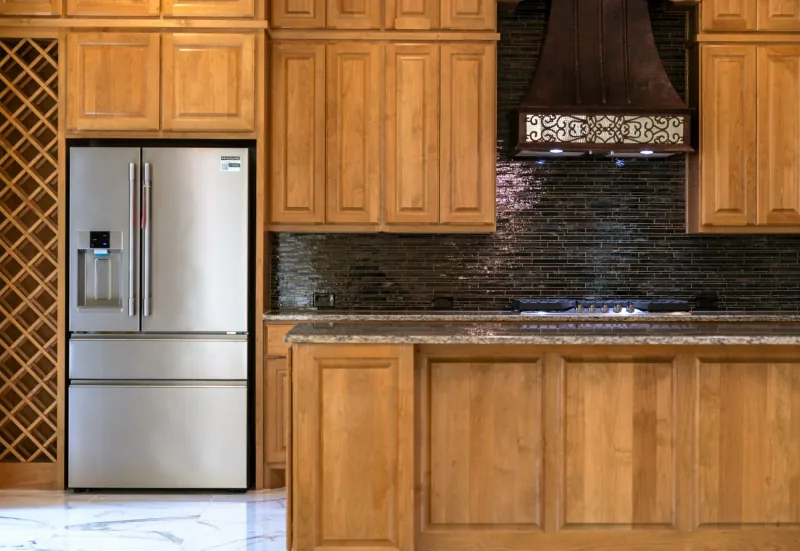
That matters here more than on any other appliance, because a built-in refrigerator is not an object standing in a kitchen. It is set flush into a cabinet run, secured to the surrounding joinery, and frequently carrying a custom door panel made to match the units. This equipment does not go to a workshop. All the work happens in place, and a proposal to take one away is a reasonable sign that somebody has not worked on one before.
It also means there is no shelf price to compare a repair against. Replacing one means the appliance, the fitting, quite possibly a new panel made to match your kitchen, and a real chance that a current model does not fit the old aperture. That is why a repair figure which would be absurd on a freestanding refrigerator is frequently the sensible decision on this equipment.
Two mechanical facts change every diagnosis. First, the classic Sub-Zero built-in series runs two entirely independent sealed systems, one for the refrigerator and one for the freezer. On an ordinary appliance a warm fridge with a cold freezer points at airflow. Here it points at the refrigerator's own compressor and evaporator, because the freezer's health tells you nothing about the refrigerator's. The reverse is useful too: both compartments warm at once is very unlikely to be two simultaneous failures, so it is almost always something they share, and that is usually the condenser.
Second, Sub-Zero specify condenser cleaning every six to twelve months, and every six in a home with pets. It sits behind the upper grille where nobody looks, and a large share of the faults we attend on this equipment trace straight back to it. The grille comes off by hand and a vacuum with a soft brush does the job, so we would genuinely rather you did it than paid us to. We include a full condenser service on every visit to this equipment in Cherryville whatever we came for, because it is the cheapest line on the invoice and it prevents more of the expensive ones than anything else we could do.
The commercial position is the same in Cherryville as it is at a Charlotte address, because the rate card on this site is not a Charlotte rate card. The diagnostic visit is $89 and it comes off the invoice in full when you approve the repair. Labour beyond that is $95 to $145 an hour. Nothing is added for the drive, and if the same fault returns after we have fixed it the return visit carries no fee at all.
What Cherryville itself changes
The kitchens in Cherryville
Cherryville was incorporated in 1881, has a population around 6,000, and its housing is old and overwhelmingly owner-occupied. That combination produces something we see here more than anywhere else in the service area: appliances that have been kept going for a long time by their owners. Thirty years of the same household in the same house means thirty years of somebody having a go, and the practical consequence is that the fault we are called to is frequently the result of a previous repair rather than a fresh failure. A part fitted that was nearly right, a connection made that has worked for years, a bypassed switch. We look for that before assuming a new fault.
The water and the power
Water service needs confirming against the address, as Cherryville sits outside the Charlotte Water area and rural properties around it are frequently on wells. Duke for power. On housing of this age the electrical service is the standing caution: an original panel with no spare capacity is common, and where an appliance genuinely needs a new circuit that is a real piece of licensed work rather than an afternoon job, which is worth knowing before the appliance is bought.
Permits and who is licensed
Swapping an appliance on an existing connection does not require a permit anywhere in this service area, and we will tell you that rather than adding a line for one nobody filed. What is regulated is the connection itself: new or altered wiring for a hard-wired appliance falls under the North Carolina electrical board, and anything on a gas supply line falls under the plumbing and heating board. Neither is appliance work and we hand both to the licensed trade. Gaston County reviews all trades across the county including in Cherryville, which keeps the answer straightforward. Where a previous repair has bypassed a safety device, we put it back rather than working around it.