
Working on built-in refrigeration in Fort Mill
Easy. This is new subdivision housing in the main: wide drives, level approaches, modern door widths and generous garages. Fort Mill is one of the more predictable towns in the service area to quote for over the phone, and delivery-day access problems are rare. Upstairs laundry is close to universal in the newer phases, which is the one thing worth mentioning when booking a washer or dryer swap.
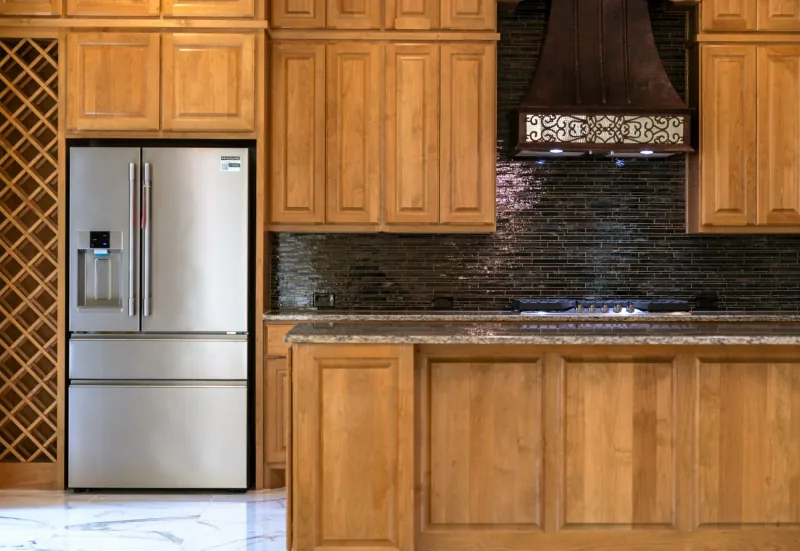
That matters here more than on any other appliance, because a built-in refrigerator is not an object standing in a kitchen. It is set flush into a cabinet run, secured to the surrounding joinery, and frequently carrying a custom door panel made to match the units. This equipment does not go to a workshop. All the work happens in place, and a proposal to take one away is a reasonable sign that somebody has not worked on one before.
It also means there is no shelf price to compare a repair against. Replacing one means the appliance, the fitting, quite possibly a new panel made to match your kitchen, and a real chance that a current model does not fit the old aperture. That is why a repair figure which would be absurd on a freestanding refrigerator is frequently the sensible decision on this equipment.
Two mechanical facts change every diagnosis. First, the classic Sub-Zero built-in series runs two entirely independent sealed systems, one for the refrigerator and one for the freezer. On an ordinary appliance a warm fridge with a cold freezer points at airflow. Here it points at the refrigerator's own compressor and evaporator, because the freezer's health tells you nothing about the refrigerator's. The reverse is useful too: both compartments warm at once is very unlikely to be two simultaneous failures, so it is almost always something they share, and that is usually the condenser.
Second, Sub-Zero specify condenser cleaning every six to twelve months, and every six in a home with pets. It sits behind the upper grille where nobody looks, and a large share of the faults we attend on this equipment trace straight back to it. The grille comes off by hand and a vacuum with a soft brush does the job, so we would genuinely rather you did it than paid us to. We include a full condenser service on every visit to this equipment in Fort Mill whatever we came for, because it is the cheapest line on the invoice and it prevents more of the expensive ones than anything else we could do.
The commercial position is the same in Fort Mill as it is at a Charlotte address, because the rate card on this site is not a Charlotte rate card. The diagnostic visit is $89 and it comes off the invoice in full when you approve the repair. Labour beyond that is $95 to $145 an hour. Nothing is added for the drive, and if the same fault returns after we have fixed it the return visit carries no fee at all.
What Fort Mill itself changes
The kitchens in Fort Mill
Fort Mill carries the highest appliance repair search volume of any town in this service area, ahead of every North Carolina suburb including Concord and Matthews, and the housing explains why. Twenty-six point eight percent of York County housing has been built since 2000 and Fort Mill holds a disproportionate share of it, so this is the newest large cohort anywhere we work. That means appliances still inside their parts-availability window, control boards still manufactured, and a repair-or-replace answer that lands on repair far more often than it does in the older towns. It also means a great many first-generation failures arriving at once.
The water and the power
Fort Mill is on its own municipal water supply rather than Charlotte Water, so the hardness figures quoted elsewhere on this site are Charlotte numbers rather than Fort Mill ones and we check the local report before applying the etching argument to a dishwasher here. Duke Energy for power. As at every South Carolina address on this site, the federal EPA Section 608 requirement for sealed-system refrigeration work applies identically on both sides of the line, since it comes from the Clean Air Act rather than from either state.
Permits and who is licensed
Swapping an appliance on an existing connection needs no permit here any more than it does over the state line, and we will say so rather than inventing a fee. What changes in South Carolina is who reviews the regulated parts. New or altered wiring for a hard-wired appliance and any work on a gas supply line are licensed trades reviewed locally rather than by a North Carolina office. The one requirement that does not change at the state line is the federal one: EPA Section 608 certification governs sealed-system refrigeration work in both states equally. The Town of Fort Mill reviews work inside town limits and York County covers addresses outside them, and neither is a North Carolina office, which occasionally surprises people who moved down from the Charlotte side.