

Working on built-in refrigeration in Indian Trail
Among the easiest in the service area. Open lots, wide driveways, level approaches, modern door openings and garages sized for a car and a chest freezer. Very little in Indian Trail presents a physical problem getting an appliance to where it needs to be, which means quotes given on the phone hold up well and delivery-day surprises are rare. Where there is a difficulty it is almost always an upstairs laundry room reached by a turn in a staircase, and that is worth mentioning when booking a washer or dryer replacement.
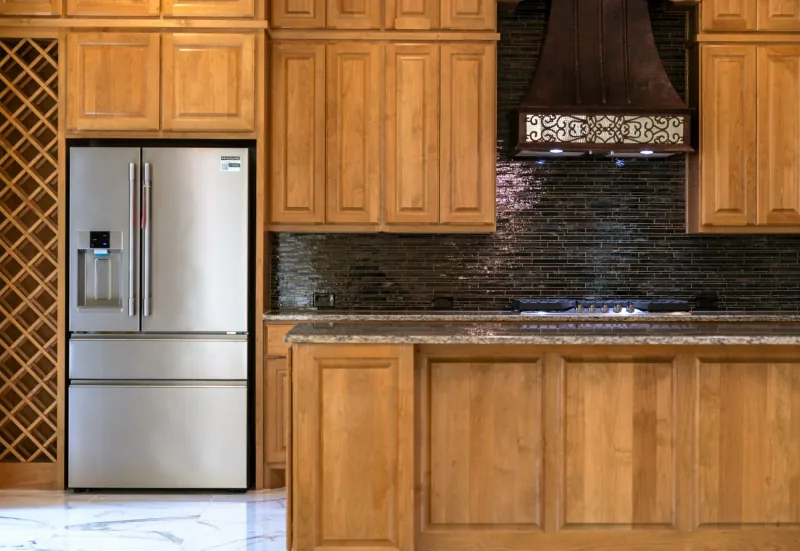
That matters here more than on any other appliance, because a built-in refrigerator is not an object standing in a kitchen. It is set flush into a cabinet run, secured to the surrounding joinery, and frequently carrying a custom door panel made to match the units. This equipment does not go to a workshop. All the work happens in place, and a proposal to take one away is a reasonable sign that somebody has not worked on one before.
It also means there is no shelf price to compare a repair against. Replacing one means the appliance, the fitting, quite possibly a new panel made to match your kitchen, and a real chance that a current model does not fit the old aperture. That is why a repair figure which would be absurd on a freestanding refrigerator is frequently the sensible decision on this equipment.
Two mechanical facts change every diagnosis. First, the classic Sub-Zero built-in series runs two entirely independent sealed systems, one for the refrigerator and one for the freezer. On an ordinary appliance a warm fridge with a cold freezer points at airflow. Here it points at the refrigerator's own compressor and evaporator, because the freezer's health tells you nothing about the refrigerator's. The reverse is useful too: both compartments warm at once is very unlikely to be two simultaneous failures, so it is almost always something they share, and that is usually the condenser.
Second, Sub-Zero specify condenser cleaning every six to twelve months, and every six in a home with pets. It sits behind the upper grille where nobody looks, and a large share of the faults we attend on this equipment trace straight back to it. The grille comes off by hand and a vacuum with a soft brush does the job, so we would genuinely rather you did it than paid us to. We include a full condenser service on every visit to this equipment in Indian Trail whatever we came for, because it is the cheapest line on the invoice and it prevents more of the expensive ones than anything else we could do.
The commercial position is the same in Indian Trail as it is at a Charlotte address, because the rate card on this site is not a Charlotte rate card. The diagnostic visit is $89 and it comes off the invoice in full when you approve the repair. Labour beyond that is $95 to $145 an hour. Nothing is added for the drive, and if the same fault returns after we have fixed it the return visit carries no fee at all.
What Indian Trail itself changes
The kitchens in Indian Trail
Indian Trail is one of the two most concentrated housing cohorts anywhere in the metro, with 59.6% built between 1990 and 2009 and a median build year of 2004. That produces a pattern we genuinely use: whole streets went up within a season or two of each other, were fitted with the same builder appliance package, and have replaced it on roughly the same timetable. So the neighbours failures are a forecast rather than an anecdote, and the part we fitted three doors down last month is frequently the part we need this month. When somebody in Indian Trail tells us three houses on the street have had the same thing done, that is useful information and we treat it as such.
The water and the power
Union County Water rather than Charlotte Water, so the hardness figure quoted elsewhere on this site is not the figure at an Indian Trail address, and we check the county report before applying the etched-glassware argument here. Power is Duke. The other utility fact that matters in this town is how uniform the electrical installations are: streets built together were wired together to the same specification by the same contractors, so where a circuit arrangement is a problem on one house it is frequently a problem on the rest, and that is worth knowing before assuming an installation fault is unique.
Permits and who is licensed
Swapping an appliance on an existing connection does not require a permit anywhere in this service area, and we will tell you that rather than adding a line for one nobody filed. What is regulated is the connection itself: new or altered wiring for a hard-wired appliance falls under the North Carolina electrical board, and anything on a gas supply line falls under the plumbing and heating board. Neither is appliance work and we hand both to the licensed trade. The Town of Indian Trail and Union County share responsibility depending on the address, and we establish which applies before any work on a circuit or a gas connection.