



Where a Weddington freezer is actually standing
Physically the easiest properties in the service area to reach and the most complicated to work on. Long drives, wide doors, generous space, and then an appliance that is set flush into joinery, secured to the cabinet run and carrying a custom door panel matched to the kitchen. Nothing here comes out easily and nothing goes to a workshop. All the work happens in place, which is normal for this equipment and is worth stating plainly, because a proposal to remove a built-in refrigerator is a sign that somebody has not worked on one.
That is the context for the question we ask first on any freezer call here, which is not what the appliance is doing but where it is. About 3% of Mecklenburg County homes have a basement, and the same is broadly true across this region, so a second freezer has nowhere to go except the garage. Across the newer housing that is close to standard equipment.
The difficulty is that most domestic freezers carry an ambient temperature rating and an attached Carolina garage is outside it for a good part of the year, at both ends. In summer the condenser is trying to reject heat into air that is already above 100F, so the compressor runs continuously, never quite reaches its set point, and wears at several times its intended rate. In winter the opposite: on many standard freezers the thermostat senses cabinet temperature, so on a 25F January morning it decides the cabinet is cold enough and switches off, and the contents soften in the middle of winter.
Neither is a fault. Both are a correctly working appliance in a position it was not designed for, and a garage-ready model is the answer rather than a repair. We would rather tell you that in Weddington than replace the same thermostat every August.
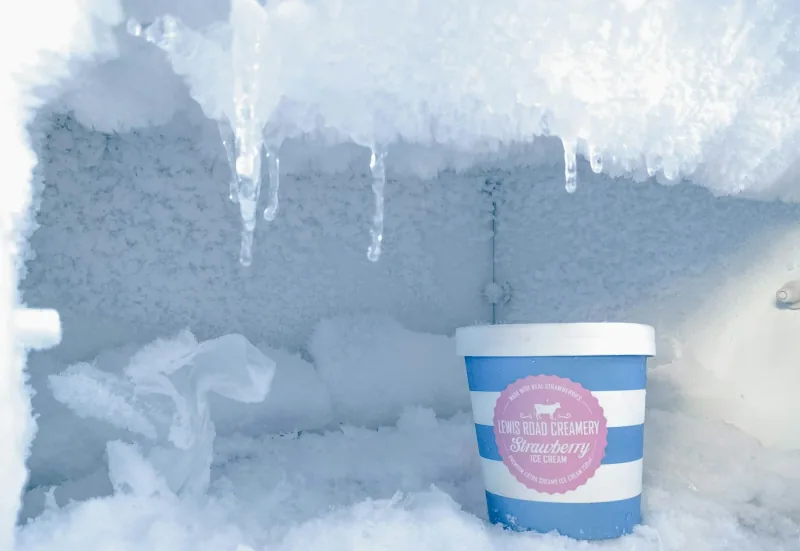
Where the freezer is genuinely in a suitable position and still failing, the diagnosis is usually the defrost circuit. A freezer that hums away exactly as it always has while the contents soften has an evaporator coil buried in ice, so the machine is refrigerating perfectly and none of it is reaching the food. Take the back panel off inside the cabinet: a coil buried in ice is the defrost circuit, and a clear coil in a warm cabinet is the sealed system. Two minutes, and it separates a modest repair from an expensive one.
The commercial position is the same in Weddington as it is at a Charlotte address, because the rate card on this site is not a Charlotte rate card. The diagnostic visit is $89 and it comes off the invoice in full when you approve the repair. Labour beyond that is $95 to $145 an hour. Nothing is added for the drive, and if the same fault returns after we have fixed it the return visit carries no fee at all.
What Weddington itself changes
The kitchens in Weddington
Weddington is the professional-brand belt of this service area and the numbers explain why: a median household income of $190,766, owner-occupancy at 95.1%, a median build year of 2000 and 43.8% of the stock built between 1980 and 1999. Those are large houses, owned rather than rented, with kitchens specified rather than supplied. So the appliances here are disproportionately built-in refrigeration, professional ranges and fitted cabinetry rather than freestanding equipment, and the repair-or-replace arithmetic changes completely as a result. A replacement is not a purchase, it is a purchase plus a fitting plus, frequently, a joiner altering a fitted kitchen to take a unit that is not the same size as the last one.
The water and the power
Union County Water rather than Charlotte Water, so the hardness numbers quoted elsewhere on this site are Charlotte numbers and not Weddington ones. Duke for power. On this equipment the utility detail that matters most is neither: it is that built-in refrigeration lives in a cabinet run drawing air through a narrow grille, and Weddington wooded lots and a substantial Piedmont pollen season mean condensers here load up faster than the manufacturer twelve-month interval assumes. Six months is the right schedule at a Weddington address, and it is free to do.
What is actually installed
Built-in and integrated refrigeration, professional ranges and cooktops, wall ovens in fitted apertures, panel-ready dishwashers and undercounter ice machines in bar and outdoor kitchen areas. Gas cooking is common here where it is not elsewhere. The recurring finds are the ones that come with this class of equipment: condensers that have not been cleaned since installation, door gaskets and hinges worn by heavy panelled doors, and control boards that run through a dealer parts channel with lead times measured in weeks rather than days.