



Where a Stallings freezer is actually standing
Easy, in the same way Indian Trail is easy: level approaches, wide drives, modern door widths and garages that will take an appliance without argument. Stallings was built late enough that nothing about the physical building presents a problem, and appliance replacement here is genuinely a matter of what fits the aperture rather than what fits through the house. Upstairs laundry rooms are the only recurring complication and only for the largest machines.
That is the context for the question we ask first on any freezer call here, which is not what the appliance is doing but where it is. About 3% of Mecklenburg County homes have a basement, and the same is broadly true across this region, so a second freezer has nowhere to go except the garage. Across the newer housing that is close to standard equipment.
The difficulty is that most domestic freezers carry an ambient temperature rating and an attached Carolina garage is outside it for a good part of the year, at both ends. In summer the condenser is trying to reject heat into air that is already above 100F, so the compressor runs continuously, never quite reaches its set point, and wears at several times its intended rate. In winter the opposite: on many standard freezers the thermostat senses cabinet temperature, so on a 25F January morning it decides the cabinet is cold enough and switches off, and the contents soften in the middle of winter.
Neither is a fault. Both are a correctly working appliance in a position it was not designed for, and a garage-ready model is the answer rather than a repair. We would rather tell you that in Stallings than replace the same thermostat every August.
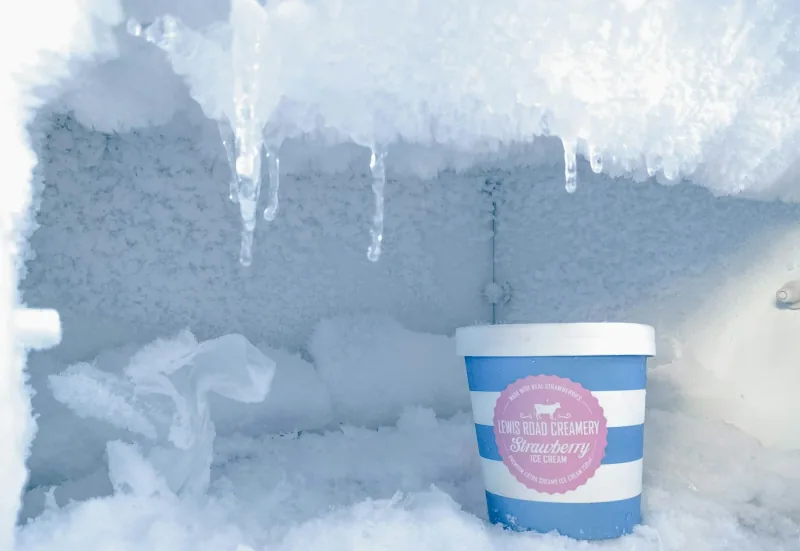
Where the freezer is genuinely in a suitable position and still failing, the diagnosis is usually the defrost circuit. A freezer that hums away exactly as it always has while the contents soften has an evaporator coil buried in ice, so the machine is refrigerating perfectly and none of it is reaching the food. Take the back panel off inside the cabinet: a coil buried in ice is the defrost circuit, and a clear coil in a warm cabinet is the sealed system. Two minutes, and it separates a modest repair from an expensive one.
The commercial position is the same in Stallings as it is at a Charlotte address, because the rate card on this site is not a Charlotte rate card. The diagnostic visit is $89 and it comes off the invoice in full when you approve the repair. Labour beyond that is $95 to $145 an hour. Nothing is added for the drive, and if the same fault returns after we have fixed it the return visit carries no fee at all.
What Stallings itself changes
The kitchens in Stallings
Stallings holds the tightest housing cohort in the whole study area, with 62.6% of it built between 1990 and 2009 and a median year of 2002. The consequence for appliances is precise: every original builder-fitted appliance in this town has been through at least one replacement cycle, and frequently two on the shorter-lived items. So unlike a newer town, what we find in a Stallings kitchen is not a matched builder package. It is a set of homeowner purchases made at different times from different makers as each original failed, which means the refrigerator, the range and the dishwasher share a kitchen and nothing else, and each one needs its own diagnosis and its own parts channel.
The water and the power
Union County Water, as with the rest of the county, so the Charlotte hardness figure does not apply and the dishwasher reasoning on this site is checked against the county report rather than assumed. Duke for power. Because the houses were built together and the appliances were not, Stallings is one of the few places where the installation is uniform and the equipment is not: the circuits, the water taps and the vent runs are all standard, and what varies is entirely what got plugged into them, which is a helpful way round rather than an unhelpful one.
What is actually installed
Electric throughout, on the pattern typical of turn-of-the-century subdivision construction: a 240-volt range circuit, a dedicated dishwasher circuit, a laundry pair upstairs and a dryer duct making its way out through the roof or an upper-storey wall. The ice supply on these houses is generally a proper tee rather than a saddle valve, because the plumbing was done to a modern standard, which removes one of the more common ice maker faults from consideration here and makes the fill tube and the inlet valve the likelier candidates.