


Whether a Rock Hill microwave is worth attending at all
York County has a median year of construction of 1993, and Rock Hill is the town that sits closest to that median rather than at either end of it. What a 1993 kitchen means in practice is a specific replacement history: the original dishwasher and range have been through one cycle, the refrigerator has generally been through two, and the appliances currently in the room were bought at different points across the last fifteen years. So a Rock Hill kitchen is a mixed-age kitchen, and the useful thing to establish on the phone is the age of the individual appliance rather than the age of the house, because the two have almost nothing to do with each other here.
This is the one page on this site that argues against itself for the first half, and it is the honest position. If your microwave stands on the worktop, replace it. A countertop microwave is a commodity appliance costing less than most repairs, we will tell you that on the phone, and we will not send anybody. That loses us the visit fee and it is plainly the right answer.
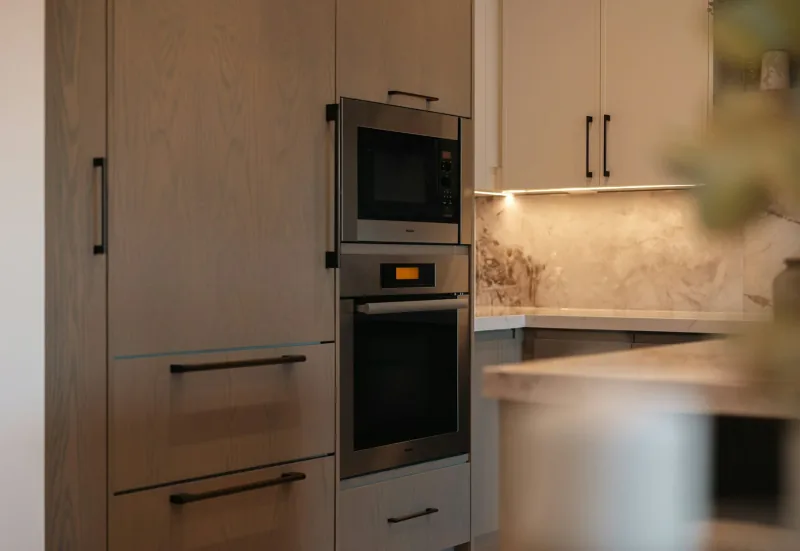
Now the exception, which is a large one in Rock Hill and everywhere else in this metro. An over-the-range microwave is not a countertop unit in a different place. It is screwed to the underside of a wall cabinet, bolted through a mounting plate, wired into a dedicated circuit rather than plugged in, and connected to the kitchen extraction, either ducted outside or recirculating through a charcoal filter. It is fitted equipment and it is part of the kitchen.
So replacement costs three things the shelf price does not include: an aperture that has to match, since the cabinet above is frequently a shortened one built around the original appliance; a duct connection that has to line up, and models differ in whether they exit at the top or the back; and an electrical connection, which makes fitting one an electrical job. Replacing one properly is regularly $600 to $900 rather than the $250 the shelf suggests. Against a repair at $130 to $310, the fifty percent rule stops applying, because the two things being compared are no longer alternatives.
One safety point that is not a formality. The high-voltage capacitor in a microwave stores a lethal charge and holds it after the appliance is unplugged. It has to be discharged through a resistor before anything inside is touched. There are plenty of appliance jobs worth attempting yourself. This is not one of them.
The commercial position is the same in Rock Hill as it is at a Charlotte address, because the rate card on this site is not a Charlotte rate card. The diagnostic visit is $89 and it comes off the invoice in full when you approve the repair. Labour beyond that is $95 to $145 an hour. Nothing is added for the drive, and if the same fault returns after we have fixed it the return visit carries no fee at all.
What Rock Hill itself changes
What is actually installed
Electric predominantly, with a 240-volt range circuit and the laundry position varying by build era in the same way it does across the North Carolina side. What differs is not the hardware but the paperwork: an installation question that would be referred to a North Carolina board at a Charlotte address is referred locally here, and a contractor who is licensed in North Carolina is not automatically licensed in South Carolina for the regulated parts of the work.
Getting an appliance in and out
Comfortable across most of the town. The 1990s and 2000s housing that makes up the bulk of Rock Hill has modern door widths and level approaches, and the older core near downtown carries the usual pre-war constraints without being unusually difficult. Being 25 miles from uptown Charlotte, this is a routine part of our service area rather than an edge of it, which is worth saying because plenty of Charlotte-based trades treat the state line as a boundary.
Permits and who is licensed
Swapping an appliance on an existing connection needs no permit here any more than it does over the state line, and we will say so rather than inventing a fee. What changes in South Carolina is who reviews the regulated parts. New or altered wiring for a hard-wired appliance and any work on a gas supply line are licensed trades reviewed locally rather than by a North Carolina office. The one requirement that does not change at the state line is the federal one: EPA Section 608 certification governs sealed-system refrigeration work in both states equally. In Rock Hill the City reviews work inside city limits and York County covers addresses outside them, and we confirm which applies before anything that touches a circuit or a gas connection.