


Whether a Salisbury microwave is worth attending at all
Salisbury holds one of the most substantial historic housing stocks in North Carolina, across the Salisbury Historic District, North Main Street from roughly 1900 to 1930, Brooklyn-South Square and North Long Street-Park Avenue, in Late Victorian, Colonial Revival and Craftsman bungalows in real quantity. For appliance work that produces a specific and unglamorous problem: this is the hardest town in the service area to physically get an appliance into or out of. Original door openings, narrow stairs, interior routes with several turns, and kitchens at the back of houses that were designed around a service arrangement nobody uses now.
This is the one page on this site that argues against itself for the first half, and it is the honest position. If your microwave stands on the worktop, replace it. A countertop microwave is a commodity appliance costing less than most repairs, we will tell you that on the phone, and we will not send anybody. That loses us the visit fee and it is plainly the right answer.
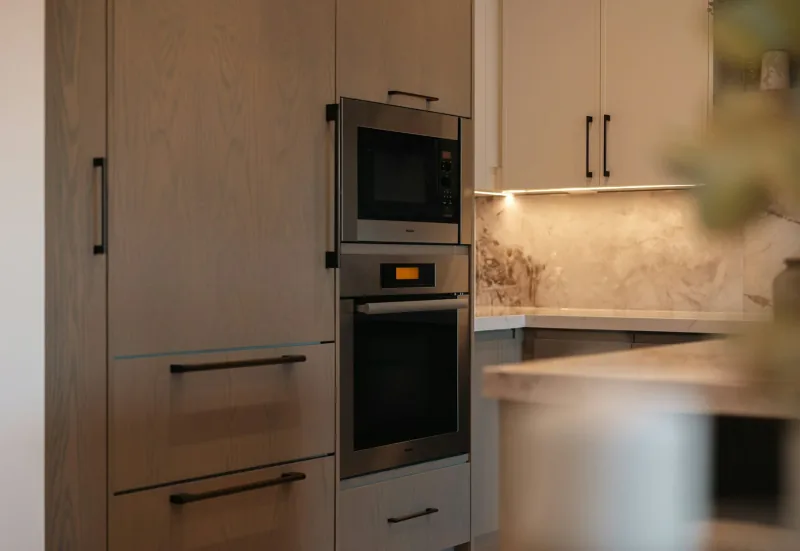
Now the exception, which is a large one in Salisbury and everywhere else in this metro. An over-the-range microwave is not a countertop unit in a different place. It is screwed to the underside of a wall cabinet, bolted through a mounting plate, wired into a dedicated circuit rather than plugged in, and connected to the kitchen extraction, either ducted outside or recirculating through a charcoal filter. It is fitted equipment and it is part of the kitchen.
So replacement costs three things the shelf price does not include: an aperture that has to match, since the cabinet above is frequently a shortened one built around the original appliance; a duct connection that has to line up, and models differ in whether they exit at the top or the back; and an electrical connection, which makes fitting one an electrical job. Replacing one properly is regularly $600 to $900 rather than the $250 the shelf suggests. Against a repair at $130 to $310, the fifty percent rule stops applying, because the two things being compared are no longer alternatives.
One safety point that is not a formality. The high-voltage capacitor in a microwave stores a lethal charge and holds it after the appliance is unplugged. It has to be discharged through a resistor before anything inside is touched. There are plenty of appliance jobs worth attempting yourself. This is not one of them.
The commercial position is the same in Salisbury as it is at a Charlotte address, because the rate card on this site is not a Charlotte rate card. The diagnostic visit is $89 and it comes off the invoice in full when you approve the repair. Labour beyond that is $95 to $145 an hour. Nothing is added for the drive, and if the same fault returns after we have fixed it the return visit carries no fee at all.
What Salisbury itself changes
What is actually installed
A century of accumulation. Appliances fitted into spaces adapted for them, connections dating from whenever each appliance was installed, supply lines extended to reach positions that suited the room rather than the plumbing, and dryer ducts routed through whatever was available. In a house of this age the connection behind the appliance is worth more attention than the appliance itself, and it is frequently where the fault turns out to be.
Getting an appliance in and out
The defining feature of working in this town, and it changes the economics of a repair. A refrigerator that came into one of these houses twenty years ago may not come out of it now, because a door has been replaced, a wall has been built, or the appliance was carried in before something else was fitted. Where that is the case a repair is not competing with a replacement on price, it is competing with a replacement that may not be practical at all. We establish the route before recommending either.
Permits and who is licensed
Swapping an appliance on an existing connection does not require a permit anywhere in this service area, and we will tell you that rather than adding a line for one nobody filed. What is regulated is the connection itself: new or altered wiring for a hard-wired appliance falls under the North Carolina electrical board, and anything on a gas supply line falls under the plumbing and heating board. Neither is appliance work and we hand both to the licensed trade. Rowan County reviews the work for Salisbury. Nothing about the historic districts changes the appliance position on a like-for-like swap, but a new circuit in one of these houses is a genuine piece of licensed electrical work.