

What a Mount Holly washing machine is plumbed into
The City of Mount Holly runs its own water supply, so the Charlotte hardness figure is not the local one and the dishwasher reasoning gets checked against the city report before it is applied. Duke for power. Given the age of the housing the electrical installations here are modern and adequate, so unlike much of Gaston County an appliance upgrade in Mount Holly rarely turns into an electrical job, and a nuisance trip is more likely to be the appliance than the circuit.
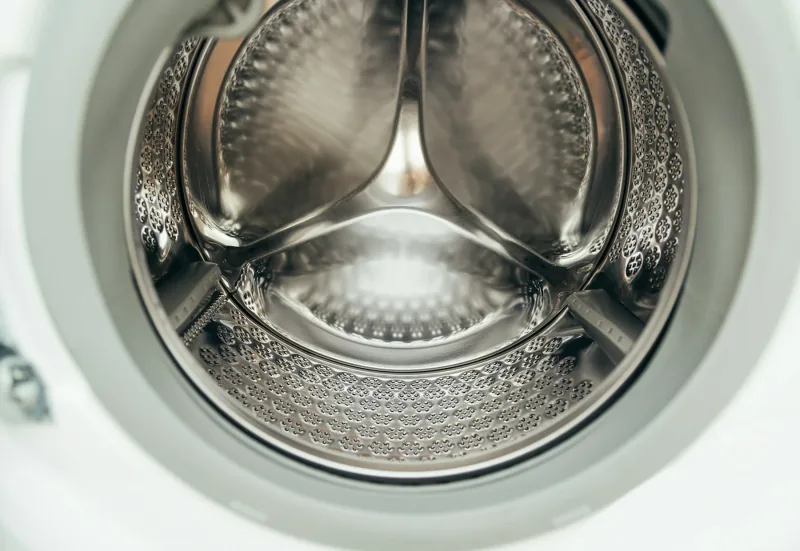
That matters because a washing machine is one of only three appliances in the house permanently connected to mains pressure, and it holds against that pressure for every hour it is not running. Two solenoid inlet valves sit closed at the back of the machine doing exactly that, roughly 165 hours a week.
Across this metro the static pressure is routinely well above 100 psi, against a code threshold of 80 psi above which a pressure-reducing valve is required in North Carolina. Plenty of houses either never had one or have one that has quietly failed open. So an inlet valve here is a wear part rather than a random failure, and the sequence is predictable: it starts to weep, which shows up as water in the drum when nobody has used the machine, then it fails outright, and eventually the supply hose behind it goes too.
That last one is the expensive one and it is barely an appliance failure at all. The Insurance Information Institute puts the average non-weather water damage claim just under $11,000, and carriers routinely treat a rubber hose that perishes with age as maintenance rather than sudden and accidental. With almost no basements anywhere in this region, a Mount Holly laundry room is usually sitting above finished rooms rather than below them.
So we put a gauge on the nearest hose bib on every washer call here and the reading goes on your paperwork. Above 80 psi we will tell you the real answer is a plumber and a pressure-reducing valve, which is a referral away from our own invoice. And we will fit braided stainless hoses while we are behind the machine, which is the least profitable thing on the page and the one that prevents the largest bill.
The commercial position is the same in Mount Holly as it is at a Charlotte address, because the rate card on this site is not a Charlotte rate card. The diagnostic visit is $89 and it comes off the invoice in full when you approve the repair. Labour beyond that is $95 to $145 an hour. Nothing is added for the drive, and if the same fault returns after we have fixed it the return visit carries no fee at all.
What Mount Holly itself changes
The kitchens in Mount Holly
Mount Holly contradicts how most content treats Gaston County. Forty-nine percent of its housing has gone up since 2000, which makes it newer than the county average and newer than Mecklenburg, and the median property value of $337,800 reflects that. For appliance work this is genuinely good news and it is worth saying plainly: half this town is on appliances young enough that their control boards are still manufactured, which is the single factor that most often ends an otherwise sound machine. Mount Holly is therefore one of the towns where a repair most reliably wins the fifty percent test, and where a diagnosis rarely ends in a parts availability problem.
Getting an appliance in and out
Straightforward across the newer half, which is most of the town: modern door widths, level approaches and space to work. The older centre along the river carries the usual constraints of pre-war housing but it is a small proportion of the addresses. On the whole Mount Holly is an easy town to work in and a reliable one to quote for over the phone.
What is actually installed
Post-2000 subdivision standard, executed to a modern specification: electric throughout, dedicated circuits, proper appliance taps rather than saddle valves, and the laundry upstairs with the dryer duct making its way out through an upper wall or the roof. That last point is the one recurring Mount Holly hardware issue, and it is the same one that runs through all the post-2000 stock in this metro: a duct with enough turns in it that the equivalent length was over the code limit on the day it was fitted.