



What a Iron Station washing machine is plumbed into
Wells are common here, and that reverses the central water argument on this site in the same way it does in Midland. Well water in this region can be hard and iron-bearing rather than soft, so a dishwasher or an ice maker fed from a well can genuinely scale, and the descaling advice that is wrong at a Charlotte address may be entirely right at an Iron Station one. Septic drainage is equally common, and that changes what a dishwasher and a washing machine are discharging into. Duke for power.
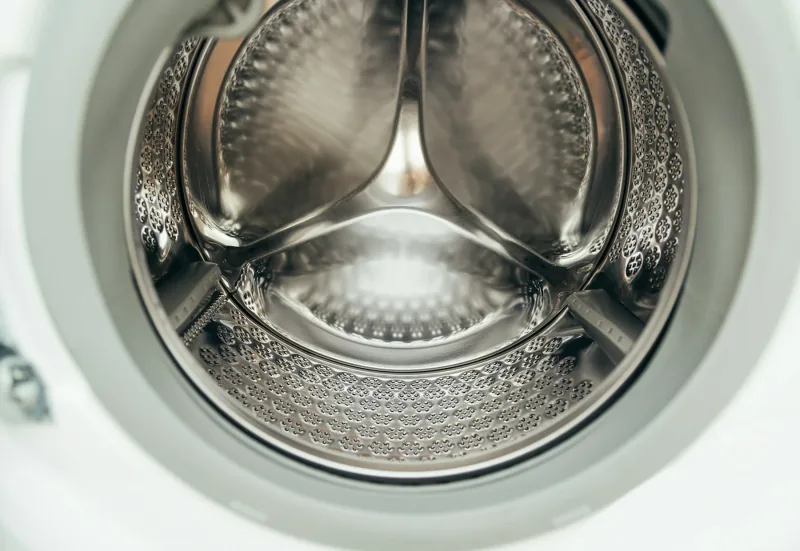
That matters because a washing machine is one of only three appliances in the house permanently connected to mains pressure, and it holds against that pressure for every hour it is not running. Two solenoid inlet valves sit closed at the back of the machine doing exactly that, roughly 165 hours a week.
Across this metro the static pressure is routinely well above 100 psi, against a code threshold of 80 psi above which a pressure-reducing valve is required in North Carolina. Plenty of houses either never had one or have one that has quietly failed open. So an inlet valve here is a wear part rather than a random failure, and the sequence is predictable: it starts to weep, which shows up as water in the drum when nobody has used the machine, then it fails outright, and eventually the supply hose behind it goes too.
That last one is the expensive one and it is barely an appliance failure at all. The Insurance Information Institute puts the average non-weather water damage claim just under $11,000, and carriers routinely treat a rubber hose that perishes with age as maintenance rather than sudden and accidental. With almost no basements anywhere in this region, a Iron Station laundry room is usually sitting above finished rooms rather than below them.
So we put a gauge on the nearest hose bib on every washer call here and the reading goes on your paperwork. Above 80 psi we will tell you the real answer is a plumber and a pressure-reducing valve, which is a referral away from our own invoice. And we will fit braided stainless hoses while we are behind the machine, which is the least profitable thing on the page and the one that prevents the largest bill.
The commercial position is the same in Iron Station as it is at a Charlotte address, because the rate card on this site is not a Charlotte rate card. The diagnostic visit is $89 and it comes off the invoice in full when you approve the repair. Labour beyond that is $95 to $145 an hour. Nothing is added for the drive, and if the same fault returns after we have fixed it the return visit carries no fee at all.
What Iron Station itself changes
The kitchens in Iron Station
Iron Station is an unincorporated community rather than a town, it is rural, and there is very little uniform subdivision building in it. There is no typical property here and consequently nothing about the address narrows a diagnosis, which is unusual even among the rural parts of this service area. What we do is ask more before booking than we would anywhere else: the age of the house, whether the water is well or mains, whether drainage is septic or sewer, and whether the appliance is in the house or an outbuilding. Those four answers replace everything a housing statistic would otherwise tell us.
Getting an appliance in and out
Long unpaved drives, outbuildings, and properties spread far enough apart that a wasted visit costs real time. That is why we ask more on the phone here than elsewhere. Appliances are frequently not all in the house: a freezer in a barn or a workshop is common, and those positions are unconditioned and almost never rated for the temperatures they see.
What is actually installed
Mixed and frequently improvised, with the septic and well questions doing most of the diagnostic work. A washing machine discharging into a septic system that is struggling produces slow-drain symptoms that get attributed to the pump, and a dishwasher on the same system does the same. On the well side, an ice maker or a dishwasher fed from untreated well water accumulates deposits that the Charlotte reasoning would tell you to rule out, and here it is genuinely the answer.