



What a Denver washing machine is plumbed into
Water service needs confirming against the address, since Denver is outside the Charlotte Water area and the rural properties between the subdivisions are frequently on wells with their own chemistry. Duke for power. The relevant utility observation for Denver is not chemistry but the garage: an attached garage in this part of the metro exceeds the ambient rating of a standard freezer for a good part of the summer and falls below it in winter, and neither is a fault in the appliance.
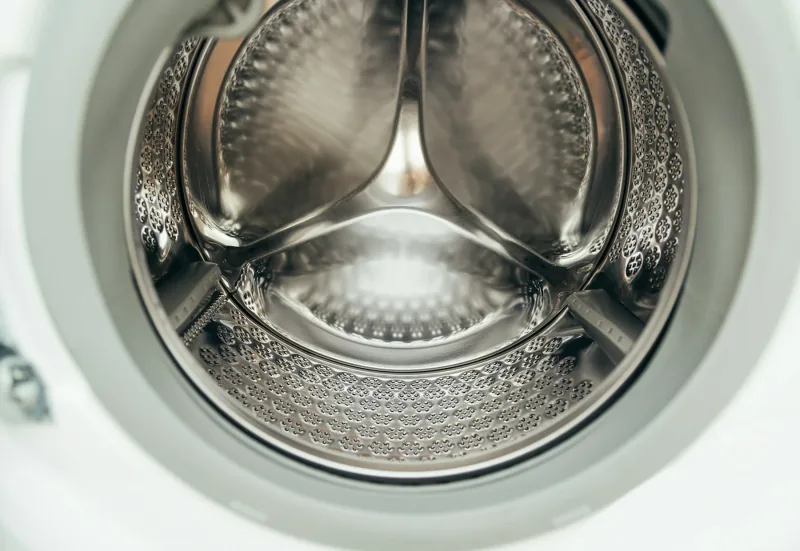
That matters because a washing machine is one of only three appliances in the house permanently connected to mains pressure, and it holds against that pressure for every hour it is not running. Two solenoid inlet valves sit closed at the back of the machine doing exactly that, roughly 165 hours a week.
Across this metro the static pressure is routinely well above 100 psi, against a code threshold of 80 psi above which a pressure-reducing valve is required in North Carolina. Plenty of houses either never had one or have one that has quietly failed open. So an inlet valve here is a wear part rather than a random failure, and the sequence is predictable: it starts to weep, which shows up as water in the drum when nobody has used the machine, then it fails outright, and eventually the supply hose behind it goes too.
That last one is the expensive one and it is barely an appliance failure at all. The Insurance Information Institute puts the average non-weather water damage claim just under $11,000, and carriers routinely treat a rubber hose that perishes with age as maintenance rather than sudden and accidental. With almost no basements anywhere in this region, a Denver laundry room is usually sitting above finished rooms rather than below them.
So we put a gauge on the nearest hose bib on every washer call here and the reading goes on your paperwork. Above 80 psi we will tell you the real answer is a plumber and a pressure-reducing valve, which is a referral away from our own invoice. And we will fit braided stainless hoses while we are behind the machine, which is the least profitable thing on the page and the one that prevents the largest bill.
The commercial position is the same in Denver as it is at a Charlotte address, because the rate card on this site is not a Charlotte rate card. The diagnostic visit is $89 and it comes off the invoice in full when you approve the repair. Labour beyond that is $95 to $145 an hour. Nothing is added for the drive, and if the same fault returns after we have fixed it the return visit carries no fee at all.
What Denver itself changes
The kitchens in Denver
Denver sits at the Lincoln County end of Lake Norman and is largely post-2000 building: big houses on big lots, concentrated in waves through the 2000s, with older rural properties scattered between them. The consequence for appliance work is a matter of quantity as much as age. These houses carry more cold storage than the metro average, and two refrigerators plus a standalone freezer is close to standard. Since almost nothing in this region has a basement, the second refrigerator and the freezer go in the garage, and that single fact accounts for a disproportionate share of the calls we take from this town.
Getting an appliance in and out
Easy at the door and occasionally long from the road. Big lots mean long drives, and the larger houses fall away towards the water in places, so an appliance destined for a lower level has a real journey. Doorways and interior routes are modern throughout, so the physical constraints that dominate the older towns on this list barely apply here. Garages are large and well suited to the second refrigerator that is usually in them.
What is actually installed
The large post-2000 standard: electric throughout with gas cooking on a substantial share, dedicated circuits, second-floor laundry with a long dryer duct, and the garage cold storage described above. The recurring Denver find is a standard-rated freezer or refrigerator standing in an attached garage, running continuously through the summer because it cannot reject heat into 105-degree air, and being reported as unreliable. A garage-ready model is the answer and no repair substitutes for one.