



What a Pineville washing machine is plumbed into
Pineville Electric has run the town supply since 1937, which makes this one of the five municipal power addresses in the service area rather than a Duke one. The practical relevance to appliances is voltage quality: sustained low or fluctuating voltage stresses compressors and control boards and produces intermittent faults that get blamed on the appliance. Where a Pineville address is losing electronics repeatedly across more than one appliance, the supply is a legitimate line of enquiry and the utility to raise it with is the town. Water is Charlotte Water, so the 32 ppm hardness figure and the dishwasher reasoning that follows from it do apply here.
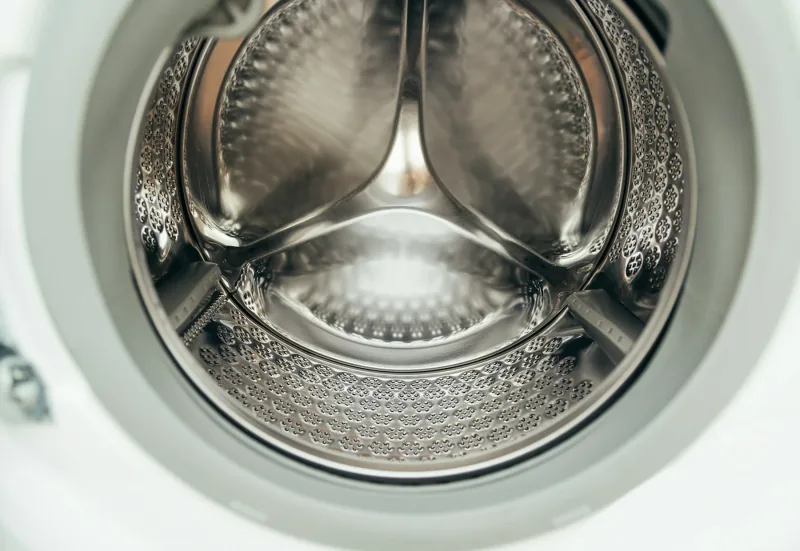
That matters because a washing machine is one of only three appliances in the house permanently connected to mains pressure, and it holds against that pressure for every hour it is not running. Two solenoid inlet valves sit closed at the back of the machine doing exactly that, roughly 165 hours a week.
Across this metro the static pressure is routinely well above 100 psi, against a code threshold of 80 psi above which a pressure-reducing valve is required in North Carolina. Plenty of houses either never had one or have one that has quietly failed open. So an inlet valve here is a wear part rather than a random failure, and the sequence is predictable: it starts to weep, which shows up as water in the drum when nobody has used the machine, then it fails outright, and eventually the supply hose behind it goes too.
That last one is the expensive one and it is barely an appliance failure at all. The Insurance Information Institute puts the average non-weather water damage claim just under $11,000, and carriers routinely treat a rubber hose that perishes with age as maintenance rather than sudden and accidental. With almost no basements anywhere in this region, a Pineville laundry room is usually sitting above finished rooms rather than below them.
So we put a gauge on the nearest hose bib on every washer call here and the reading goes on your paperwork. Above 80 psi we will tell you the real answer is a plumber and a pressure-reducing valve, which is a referral away from our own invoice. And we will fit braided stainless hoses while we are behind the machine, which is the least profitable thing on the page and the one that prevents the largest bill.
The commercial position is the same in Pineville as it is at a Charlotte address, because the rate card on this site is not a Charlotte rate card. The diagnostic visit is $89 and it comes off the invoice in full when you approve the repair. Labour beyond that is $95 to $145 an hour. Nothing is added for the drive, and if the same fault returns after we have fixed it the return visit carries no fee at all.
What Pineville itself changes
The kitchens in Pineville
Pineville has been building continuously since it was incorporated in 1873, and unlike most of the towns in this service area there is no dominant cohort to generalise from. Twenty-one percent of the stock went up in the 2000s and 22.1% between 2010 and 2019, and behind that sits a genuinely old core. So Pineville is the town where we assume least: two houses a few streets apart can have kitchens forty years apart in design, wiring and appliance generation, and the same reported symptom can have entirely different likely causes at each. Where most towns let you narrow the diagnosis from the address, Pineville does not, and that is worth knowing rather than working around.
Getting an appliance in and out
Varies with the era of the house rather than with the part of town. The newer building is straightforward in the usual way. The older core carries the constraints that come with nineteenth and early twentieth century housing: original openings, steps to the front door, and interior kitchens reached through more than one doorway. Since the two are interleaved rather than separated, we ask about the route on the phone in Pineville more consistently than we do in towns with a clearer split.
What is actually installed
A genuine mixture, and it follows the build era rather than any town-wide pattern. Ground-floor laundry with a short dryer run in the older housing, second-floor laundry with a long one in the newer. Electric predominates but there is gas cooking in both halves. The recurring Pineville hardware note is that appliances have been added to older houses over long periods, so the connection behind an appliance is frequently newer than the house and older than the appliance, and it is worth looking at before assuming a fault is internal.