


What is in a Kannapolis kitchen, and whether the board is still made
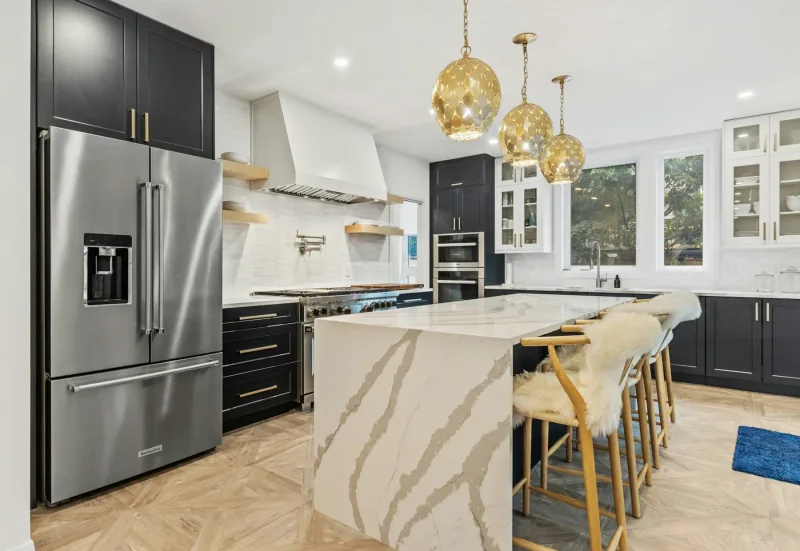
Kannapolis has a genuine barbell distribution: 29.7% of the housing predates 1960, most of it the former Cannon Mills village, and 40.7% went up in 2000 or later. Those two halves produce the same appliance conversation from opposite directions, and it is a dimensional one rather than a financial one. The mill-village kitchens have alcoves sized for the refrigerators of the 1950s, which were both narrower and shallower than anything sold today. The post-2000 kitchens were built around a 36-inch counter-depth opening. So in Kannapolis the question that decides a repair-or-replace call more often than price is simply whether a replacement will go in the space, and we measure rather than guess.
That matters more on a refrigerator than on anything else in the house, because the practical limit on repairing one is rarely mechanical. Fans, defrost heaters, thermistors, dampers and door seals are all ordinary parts at ordinary money, and they stay available for a long time. What ends a refrigerator is either the sealed system or a control board that is no longer manufactured.
The sealed system is a certified line as well as a price line. It is the closed refrigerant circuit: compressor, condenser, evaporator, drier and the tubing between them. Under the Clean Air Act, 40 CFR Part 82 Subpart F, anyone who opens that circuit must hold EPA Section 608 certification, and for household refrigeration the class is Type I. We hold it, and the number goes on your Kannapolis paperwork for any sealed-system job whether or not you think to ask.
The price line runs in the same place. Everything outside the sealed system is $130 to $500. Anything inside it is $700 to $1,250 and up. Against a mean refrigerator service life of 14.3 years, that difference decides the whole question, which is why we establish which side of it you are on and tell you before anything is dismantled rather than after.
One symptom is worth stating plainly here. A warm fridge with a cold freezer is almost never the compressor. All the cold on a normal refrigerator is made in the freezer and blown across, so a cold freezer proves the refrigeration is working. It is an evaporator fan, an iced-up defrost circuit or a stuck damper, and all three sit on the cheap side of the line.
The commercial position is the same in Kannapolis as it is at a Charlotte address, because the rate card on this site is not a Charlotte rate card. The diagnostic visit is $89 and it comes off the invoice in full when you approve the repair. Labour beyond that is $95 to $145 an hour. Nothing is added for the drive, and if the same fault returns after we have fixed it the return visit carries no fee at all.
What Kannapolis itself changes
The water and the power
The City of Kannapolis runs its own water supply, so the Charlotte hardness figure is not the number here and the soft-water reasoning is checked against the city report before it is applied to a dishwasher or an ice maker. Duke for power. In the mill-village half the electrical service is the recurring issue: those houses were built for lighting and very little else, and while they have all been rewired at some point, the panel capacity frequently reflects an earlier idea of what a kitchen contains.
Getting an appliance in and out
Sharply split. The post-2000 half is easy in every respect. The mill village is not: small houses set close together, original door openings, short interior runs with more than one turn, and kitchens that were laid out when a refrigerator was a small object. Bringing a modern French-door appliance into one of those houses is frequently not possible without removing a door, and occasionally is not possible at all. That is worth establishing before a purchase rather than after a delivery.
What is actually installed
Electric predominates on both halves. In the newer housing the standard modern arrangement applies. In the mill village the appliances have been retro-fitted over decades into a house that had none of them originally, so the dishwasher is in a converted cabinet, the ice supply is frequently a saddle valve on the nearest accessible pipe, and the dryer vents through whatever wall was closest. Those improvised arrangements are usually the actual fault rather than the appliance connected to them.