



What is in a Waxhaw kitchen, and whether the board is still made
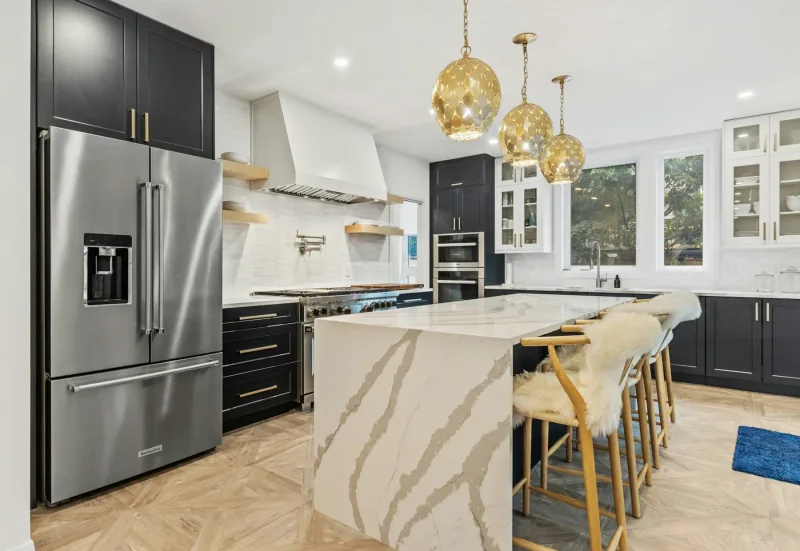
Waxhaw is two towns with a railway between them. The subdivision half accounts for 2,282 homes built between 2000 and 2009, and those are conventional modern kitchens with conventional modern appliances. The other half is a 93-building National Register district built between 1888 and 1940, and there the kitchens were installed into rooms that were built for something else. That is not a picturesque detail, it is the constraint that decides every repair-or-replace conversation in the district: the appliance footprint is fixed by the room, and a replacement that is two inches wider is not a replacement at all. We measure the aperture before making a recommendation on any Waxhaw address in the older half.
That matters more on a refrigerator than on anything else in the house, because the practical limit on repairing one is rarely mechanical. Fans, defrost heaters, thermistors, dampers and door seals are all ordinary parts at ordinary money, and they stay available for a long time. What ends a refrigerator is either the sealed system or a control board that is no longer manufactured.
The sealed system is a certified line as well as a price line. It is the closed refrigerant circuit: compressor, condenser, evaporator, drier and the tubing between them. Under the Clean Air Act, 40 CFR Part 82 Subpart F, anyone who opens that circuit must hold EPA Section 608 certification, and for household refrigeration the class is Type I. We hold it, and the number goes on your Waxhaw paperwork for any sealed-system job whether or not you think to ask.
The price line runs in the same place. Everything outside the sealed system is $130 to $500. Anything inside it is $700 to $1,250 and up. Against a mean refrigerator service life of 14.3 years, that difference decides the whole question, which is why we establish which side of it you are on and tell you before anything is dismantled rather than after.
One symptom is worth stating plainly here. A warm fridge with a cold freezer is almost never the compressor. All the cold on a normal refrigerator is made in the freezer and blown across, so a cold freezer proves the refrigeration is working. It is an evaporator fan, an iced-up defrost circuit or a stuck damper, and all three sit on the cheap side of the line.
The commercial position is the same in Waxhaw as it is at a Charlotte address, because the rate card on this site is not a Charlotte rate card. The diagnostic visit is $89 and it comes off the invoice in full when you approve the repair. Labour beyond that is $95 to $145 an hour. Nothing is added for the drive, and if the same fault returns after we have fixed it the return visit carries no fee at all.
What Waxhaw itself changes
The water and the power
Union County Water rather than Charlotte Water, so the hardness figures this site quotes for Charlotte are not the Waxhaw numbers and we check the county report before applying the soft-water reasoning to a dishwasher here. Duke for power. In the historic district the more pressing utility question is the electrical service: houses of that era have been rewired at various points by various people, and what looks like a modern circuit at the socket is not always a modern circuit at the panel, which is worth establishing before adding anything that draws current.
Getting an appliance in and out
The single most access-constrained town in Union County, and it is entirely down to which half you are in. The subdivisions are straightforward. The historic district is not: narrow lots, houses close to the street, original door openings, and interior routes that were laid out before anybody imagined a 36-inch French door refrigerator. Getting an appliance in or out of one of those houses is a planned operation, and where a repair keeps an existing appliance in place that is worth considerably more here than the price difference suggests.
What is actually installed
In the newer half, the usual pattern: electric, 240-volt range, upstairs laundry, long dryer runs. In the district, a mixture of everything fitted over a century, including appliances squeezed into alcoves, ice supplies run off saddle valves clamped to accessible pipework, and dryer ducts routed through whatever space existed rather than the shortest path. That last one produces the classic Waxhaw dryer call: a machine that dries poorly, an element that has been replaced once already, and a duct with six turns in it.