



What is in a Midland kitchen, and whether the board is still made
Midland is the rural end of Cabarrus County, with farmhouses and older rural properties standing alongside new building on large lots, and two houses a mile apart can differ in almost every respect that matters. There is no dominant cohort and no typical property, so nothing about the address narrows the diagnosis. What we do instead is ask more on the phone than we would in a subdivision town: the age of the house, the age of the appliance, whether the water is mains or well, and whether the property is on septic. Those four answers do more work here than any generalisation about the town could.
That matters more on a refrigerator than on anything else in the house, because the practical limit on repairing one is rarely mechanical. Fans, defrost heaters, thermistors, dampers and door seals are all ordinary parts at ordinary money, and they stay available for a long time. What ends a refrigerator is either the sealed system or a control board that is no longer manufactured.
The sealed system is a certified line as well as a price line. It is the closed refrigerant circuit: compressor, condenser, evaporator, drier and the tubing between them. Under the Clean Air Act, 40 CFR Part 82 Subpart F, anyone who opens that circuit must hold EPA Section 608 certification, and for household refrigeration the class is Type I. We hold it, and the number goes on your Midland paperwork for any sealed-system job whether or not you think to ask.
The price line runs in the same place. Everything outside the sealed system is $130 to $500. Anything inside it is $700 to $1,250 and up. Against a mean refrigerator service life of 14.3 years, that difference decides the whole question, which is why we establish which side of it you are on and tell you before anything is dismantled rather than after.
One symptom is worth stating plainly here. A warm fridge with a cold freezer is almost never the compressor. All the cold on a normal refrigerator is made in the freezer and blown across, so a cold freezer proves the refrigeration is working. It is an evaporator fan, an iced-up defrost circuit or a stuck damper, and all three sit on the cheap side of the line.
The commercial position is the same in Midland as it is at a Charlotte address, because the rate card on this site is not a Charlotte rate card. The diagnostic visit is $89 and it comes off the invoice in full when you approve the repair. Labour beyond that is $95 to $145 an hour. Nothing is added for the drive, and if the same fault returns after we have fixed it the return visit carries no fee at all.
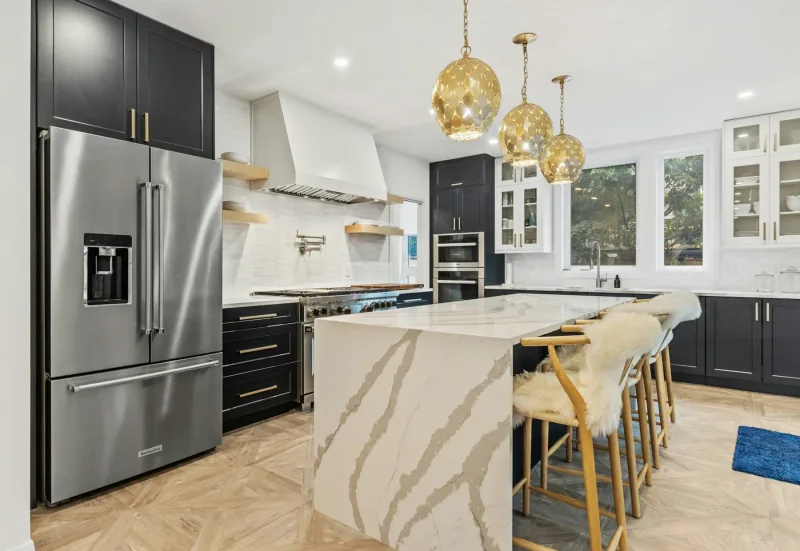
What Midland itself changes
The water and the power
This is the one part of the service area where the central water argument on this site reverses, and it is worth being precise about it. Private wells are common in rural Cabarrus, and well water in this region can be genuinely hard and iron-bearing rather than soft. So the descaling advice that is wrong at a Charlotte address may be entirely right at a Midland one: a well-fed ice maker or dishwasher here can genuinely scale up, and a filter and a descaling routine are doing real work rather than solving a problem that does not exist. We ask about the supply before applying any of the reasoning that holds elsewhere. Duke for power.
Getting an appliance in and out
Long unpaved drives and outbuildings are the recurring practical features, and both matter. A van reaching the door is not guaranteed in wet weather, and appliances are frequently not all in the house: a second refrigerator or freezer in a barn, a workshop or a detached garage is common out here. Those outbuilding positions are frequently unconditioned and unrated, which is a diagnosis in itself rather than an inconvenience.
What is actually installed
Mixed, and the septic question changes one thing specifically. Where a property is on septic rather than mains drainage, what a dishwasher and a washing machine discharge into is a genuine consideration, and a system under strain shows up as slow draining that gets attributed to the appliance. Electric predominates, gas is bottled rather than piped in much of the area, and the appliances in outbuildings are frequently older equipment that has been moved out of the house rather than bought for the position.