


What is dissolved in Kannapolis water, and what it does to glass
The City of Kannapolis runs its own water supply, so the Charlotte hardness figure is not the number here and the soft-water reasoning is checked against the city report before it is applied to a dishwasher or an ice maker. Duke for power. In the mill-village half the electrical service is the recurring issue: those houses were built for lighting and very little else, and while they have all been rewired at some point, the panel capacity frequently reflects an earlier idea of what a kitchen contains.
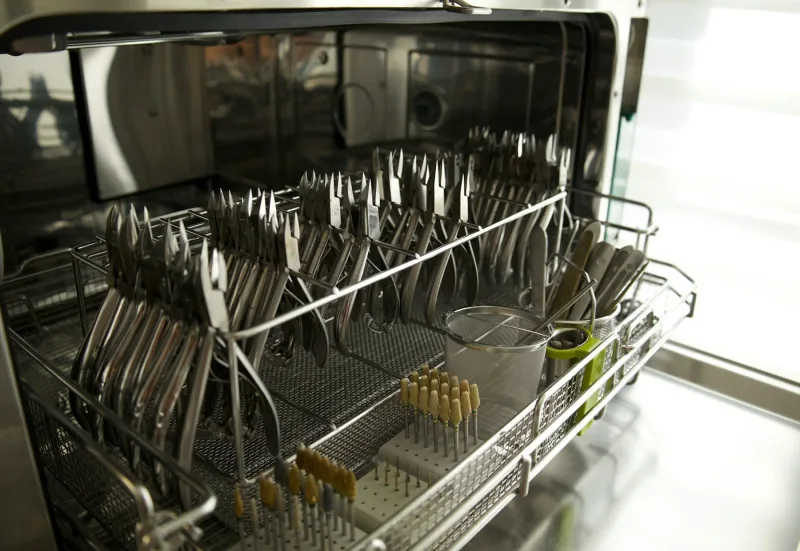
Establishing that matters here more than on any other appliance, because the single most useful thing we know about dishwashers in this region inverts the advice everybody has already read. Charlotte Water runs at 32 parts per million hardness, about 1.9 grains per gallon, with total dissolved solids at 59. That is soft. Every national troubleshooting article about cloudy glassware starts from limescale, and limescale is not what is happening.
Do one test before anything else. Soak a cloudy glass in white vinegar for a few minutes. If the cloudiness lifts, it is mineral film and it is a hard-water problem. If nothing changes, it is etching, which is not a deposit at all: it is material removed from the surface of the glass, and it is permanent.
The mechanism is documented by the appliance manufacturers themselves. Dishwasher detergent is built around polyphosphates and other softening agents because it is formulated assuming there is hardness to deal with. Put a full dose into water that is already soft and the softening component has nothing to act on, so the remaining alkalinity works on the next available surface. Glass is a silicate with metal ions in its surface, and it loses them.
The fix is to halve the detergent dose, and it is free. We will say that on the phone rather than booking a visit for it, because cloudy glassware regularly gets read as a dishwasher that has stopped cleaning and ends in a replaced appliance that does exactly the same thing.
Where the fault is genuinely mechanical in Kannapolis, the order is filter, drain hose loop and waste disposal before anyone quotes a drain pump, and an inlet valve quoted with a pressure reading, for the same reason it is on a washing machine.
The commercial position is the same in Kannapolis as it is at a Charlotte address, because the rate card on this site is not a Charlotte rate card. The diagnostic visit is $89 and it comes off the invoice in full when you approve the repair. Labour beyond that is $95 to $145 an hour. Nothing is added for the drive, and if the same fault returns after we have fixed it the return visit carries no fee at all.
What Kannapolis itself changes
The kitchens in Kannapolis
Kannapolis has a genuine barbell distribution: 29.7% of the housing predates 1960, most of it the former Cannon Mills village, and 40.7% went up in 2000 or later. Those two halves produce the same appliance conversation from opposite directions, and it is a dimensional one rather than a financial one. The mill-village kitchens have alcoves sized for the refrigerators of the 1950s, which were both narrower and shallower than anything sold today. The post-2000 kitchens were built around a 36-inch counter-depth opening. So in Kannapolis the question that decides a repair-or-replace call more often than price is simply whether a replacement will go in the space, and we measure rather than guess.
Getting an appliance in and out
Sharply split. The post-2000 half is easy in every respect. The mill village is not: small houses set close together, original door openings, short interior runs with more than one turn, and kitchens that were laid out when a refrigerator was a small object. Bringing a modern French-door appliance into one of those houses is frequently not possible without removing a door, and occasionally is not possible at all. That is worth establishing before a purchase rather than after a delivery.
Permits and who is licensed
Swapping an appliance on an existing connection does not require a permit anywhere in this service area, and we will tell you that rather than adding a line for one nobody filed. What is regulated is the connection itself: new or altered wiring for a hard-wired appliance falls under the North Carolina electrical board, and anything on a gas supply line falls under the plumbing and heating board. Neither is appliance work and we hand both to the licensed trade. The City of Kannapolis and Cabarrus County split the work, and the county line running through this town complicates that more than it does elsewhere, so we confirm the reviewing office against the specific address.