

What a Mount Holly oven is fitted into
Post-2000 subdivision standard, executed to a modern specification: electric throughout, dedicated circuits, proper appliance taps rather than saddle valves, and the laundry upstairs with the dryer duct making its way out through an upper wall or the roof. That last point is the one recurring Mount Holly hardware issue, and it is the same one that runs through all the post-2000 stock in this metro: a duct with enough turns in it that the equivalent length was over the code limit on the day it was fitted.
The reason that matters is that ovens are where the repair-or-replace arithmetic most often misleads people, and the misleading part is the installation rather than the appliance.
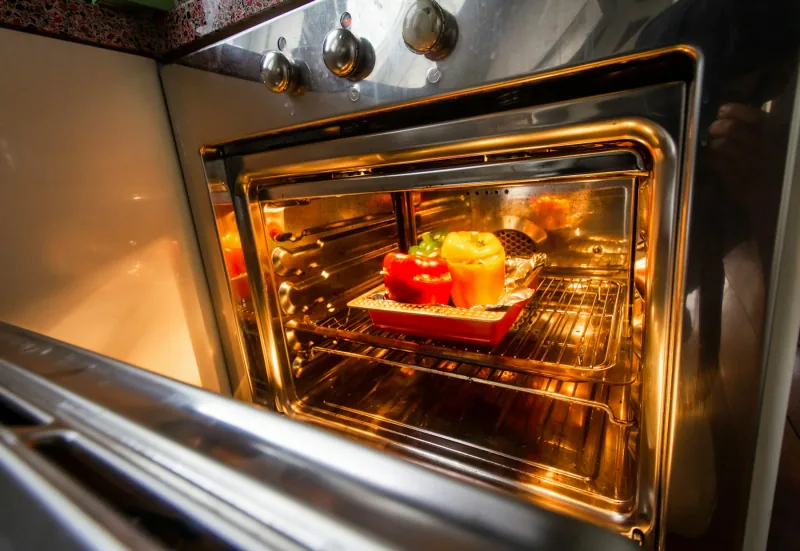
The rule people apply is the fifty percent rule: do not spend more than half the cost of a comparable new appliance on repairing the old one. It was written about a machine you can wheel out of a shop. A wall oven is cut into a cabinet. The aperture has a width, a height and a depth, the trim overlaps the surrounding joinery, and the appliance is usually hard-wired rather than plugged. Replacing one means finding a current model that fits an opening built around a unit from ten or twenty years ago, and where it does not fit you are into a joiner altering a fitted kitchen. So a $400 repair on a wall oven in Mount Holly is not competing with a $700 appliance, it is competing with an appliance plus an electrician plus quite possibly a joiner. We measure the aperture and check the connection before recommending either way.
The other thing worth publishing, because it costs us work to say it: the self-clean cycle is the leading cause of the dead ovens we attend. Pyrolytic cleaning takes the cavity to 800 or 900F for two to four hours, far beyond anything cooking requires, and three things fail as a result. The thermal fuse, which is a one-shot device fitted precisely so it goes before something costlier does. The control board, which lives immediately above the cavity where the heat rises. And the door lock motor, which leaves the oven dead and locked shut.
So the advice is simple. Do not run self-clean the week you need the oven, and preferably do not run it at all. Clean the cavity cold, by hand. It is tedious and it blows nothing.
The commercial position is the same in Mount Holly as it is at a Charlotte address, because the rate card on this site is not a Charlotte rate card. The diagnostic visit is $89 and it comes off the invoice in full when you approve the repair. Labour beyond that is $95 to $145 an hour. Nothing is added for the drive, and if the same fault returns after we have fixed it the return visit carries no fee at all.
What Mount Holly itself changes
The kitchens in Mount Holly
Mount Holly contradicts how most content treats Gaston County. Forty-nine percent of its housing has gone up since 2000, which makes it newer than the county average and newer than Mecklenburg, and the median property value of $337,800 reflects that. For appliance work this is genuinely good news and it is worth saying plainly: half this town is on appliances young enough that their control boards are still manufactured, which is the single factor that most often ends an otherwise sound machine. Mount Holly is therefore one of the towns where a repair most reliably wins the fifty percent test, and where a diagnosis rarely ends in a parts availability problem.
The water and the power
The City of Mount Holly runs its own water supply, so the Charlotte hardness figure is not the local one and the dishwasher reasoning gets checked against the city report before it is applied. Duke for power. Given the age of the housing the electrical installations here are modern and adequate, so unlike much of Gaston County an appliance upgrade in Mount Holly rarely turns into an electrical job, and a nuisance trip is more likely to be the appliance than the circuit.
Permits and who is licensed
Swapping an appliance on an existing connection does not require a permit anywhere in this service area, and we will tell you that rather than adding a line for one nobody filed. What is regulated is the connection itself: new or altered wiring for a hard-wired appliance falls under the North Carolina electrical board, and anything on a gas supply line falls under the plumbing and heating board. Neither is appliance work and we hand both to the licensed trade. Gaston County reviews all trades across the county including inside Mount Holly, which keeps the answer here simpler than in the towns split between a town and a county office.