


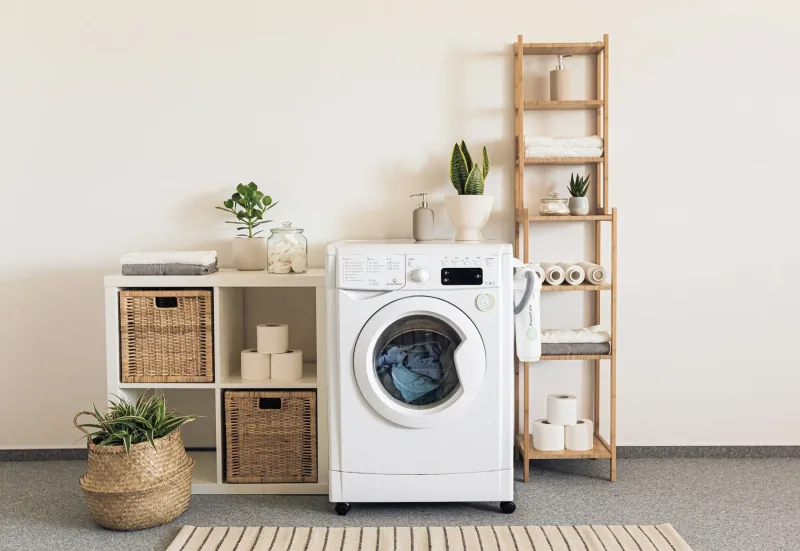
The duct run behind a Troutman dryer
Two standards a mile apart. The village centre carries appliances added to an older house over decades with the improvised connections that go with that, and ground-floor laundry with short duct runs. The subdivision ring carries the modern pattern throughout: dedicated circuits, upstairs laundry, long dryer ducts and a garage freezer. Both are common here and neither can be assumed.
That is the context for the one measurement that decides most dryer calls. The North Carolina residential code adopts IRC M1502.4.6: a maximum exhaust duct length of 35 feet, measured from the transition duct at the back of the machine to the terminal outside. Then the deductions in Table M1502.4.6.1 apply: five feet for every 90-degree elbow and 2.5 feet for every 45.
So 22 feet of actual duct with four right-angle bends in it is 42 feet of equivalent length, and it is over the limit by seven. It does not look over the limit. It looks like a short duct.
Below a certain air velocity lint stops being carried along and starts settling on the duct wall, so an over-length run progressively closes itself. Drying times stretch, the machine cuts out on its thermal protection, and eventually the heating element or the thermal fuse fails. That is the part everybody quotes, and fitting a new one into the same duct buys the same failure on the same schedule. The NFPA attributes roughly 14,000 home fires a year to clothes dryers and names failure to clean, meaning lint accumulation in the duct, as the leading cause.
We measure the run in Troutman, count the elbows, calculate the equivalent length and write it on your paperwork against the 35-foot limit. Where it is over we quote the rework as a separate line you can decline. Where it is simply dirty we clear it and say so, because that is the cheaper answer and it is frequently the true one.
The commercial position is the same in Troutman as it is at a Charlotte address, because the rate card on this site is not a Charlotte rate card. The diagnostic visit is $89 and it comes off the invoice in full when you approve the repair. Labour beyond that is $95 to $145 an hour. Nothing is added for the drive, and if the same fault returns after we have fixed it the return visit carries no fee at all.
What Troutman itself changes
The kitchens in Troutman
Troutman sits on the I-77 corridor between Statesville and Mooresville, with an older village centre and an expanding subdivision ring around it. What that produces is a town where the address genuinely does not tell you what you are going to find: two houses a mile apart can have kitchens fifty years apart in wiring, layout and appliance generation. It is one of the few towns on this list where we do not form an expectation from the postal town at all, and where the questions on the phone about the age of the house and the age of the appliance carry all the weight that a housing statistic carries elsewhere.
The water and the power
Water service needs confirming for the specific address, since Troutman sits between supply areas and the rural edges are frequently on wells with their own chemistry. Duke for power. In the older village centre the electrical service reflects its era and adding a circuit is a real job; in the newer ring it is modern throughout. That difference is more useful than anything the town-level data would tell you.
Getting an appliance in and out
Easy in the new ring, constrained in the old centre in the usual pre-war way: original openings, steps, and interior routes with turns in them. Because the two are physically close rather than separated, we ask about the route on the phone here rather than assuming from the address, which is the same approach we take in Pineville and for the same reason.